





























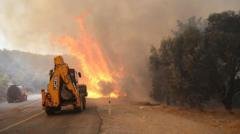
Two police‑affiliated firefighters lost their lives on the Greek island of Crete after a sudden shift in wind direction turned an already raging wildfire into a lethal inferno. The blaze, which has scorched more than 3,200 hectares, forced the evacuation of multiple villages and cut off essential services to south‑eastern Europe.
According to the Greek Forestry Service, the wildfire ignited on July 22 near the Aegean coast and expanded rapidly under gusts exceeding 80 km/h. The incident claimed the lives of 38‑year‑old Petros Voulgaris of the Heraklion fire brigade and 27‑year‑old Manuel Kon, a local volunteer. Both men were battling the flames when a sudden surge of wind breached their protective perimeter.
The tragedy has amplified the already overwhelming burden on emergency systems across the Mediterranean. In the past week, Greece, Italy and Spain have reported an average of 3.5 active fires per day, accounting for more than 12,000 hectares of lost vegetation. Heatwaves and prolonged drought conditions have been cited by scientists as key contributors to the surge in fire activity.
Why it matters
The loss of firefighters in Crete is a stark reminder for Gulf states of the escalating climate risks that transcend borders. As the UAE intensifies its adaptation agenda—investing in heat‑resilient infrastructure and expanding the National Climate Change Plan—these incidents underscore the urgency of cross‑regional cooperation on wildfire preparedness and firefighting technology.
Moreover, the event highlights the challenges of maintaining volunteer fire services in remote areas. The two fallen firefighters were part of a community‑based response network that supplements the limited national budget for emergency services on isolated islands.
For the wider European Union, the crisis obliges member states to tighten coordination on firefighting resources, share best‑practice data, and accelerate the deployment of advanced detection and suppression systems that could also benefit Gulf countries facing desert fires.
What’s next
The Greek government has convened an emergency task force that will review the incident’s communication gaps and equipment deficiencies. A provisional budget of €25 million has already been approved for new thermal‑imaging tech and high‑capacity water tanks.
Internationally, the World Meteorological Organisation will issue a comprehensive climate‑fire forecast for southern Europe, with a focus on predictive models that detect wind shifts of the magnitude that wreaked havoc in Crete’s firefighting response.
In the Gulf, the Ministry of Climate Change and Environment has announced plans to host a regional wildfire‑safety summit next month, inviting ministries from Turkey, Egypt and Saudi Arabia to exchange protocols and response strategies.
The aftermath of Crete’s loss will serve as a reminder that emergency services worldwide must adapt to a climate that is increasingly violent and unpredictable.
Additional reporting by The Dubai Herald newsroom.