



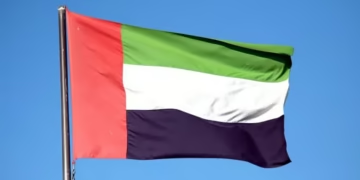


















GENEVA / ABU DHABI — The United Arab Emirates has firmly dismissed claims regarding its alleged involvement in Sudan’s ongoing civil war, reaffirming that it has not supplied weapons or military materiel to any combatant since hostilities erupted in April 2023.
Responding directly to findings published by the UN-mandated International Fact-Finding Mission (FFM), the UAE Mission to the United Nations in Geneva issued a formal statement emphasizing its transparent and substantive engagement with the investigators. The mission insisted that all claims must adhere to rigorous, verified evidentiary standards rather than uncorroborated reports.
Commitment to Sanctions and Domestic Crackdowns
In its response, the UAE reiterated its adherence to the sanctions regime enforced by the UN Security Council. It also called for extending the international arms embargo across Sudan to halt external military supplies to both warring factions—the Sudanese Armed Forces (SAF) and the Rapid Support Forces (RSF).
As part of its domestic enforcement against illicit networks, UAE authorities highlighted the referral of a major arms smuggling syndicate to the Abu Dhabi Federal Court of Appeal earlier this year. UAE Attorney General Dr. Hamad Saif Al Shamsi charged 13 individuals and six UAE-registered shell companies with illicit weapons trafficking, forgery, and money laundering.
State investigations revealed that the transactions were initiated at the behest of the Port Sudan Authority’s armament committee, headed by SAF chief Abdel Fattah Al Burhan, involving coordination with former Sudanese intelligence figures including Salah Gosh. The UN report acknowledged the domestic legal frameworks the UAE has leveraged to hold private entities accountable.
Renewed Push for Ceasefire and Civilian Governance
Condemning widespread violations of international humanitarian law committed by both the SAF and the RSF, the UAE called on the international community to prioritize diplomacy.
The UAE diplomatic mission pressed for an immediate, unconditional ceasefire, rapid humanitarian corridors, and the initiation of a civilian-led political transition entirely free from military control and extremist factions.