






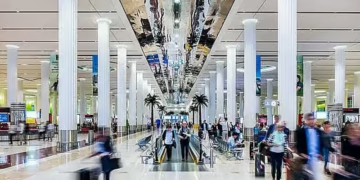

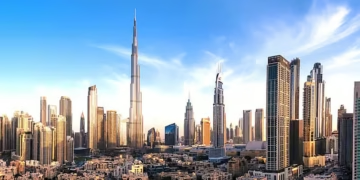
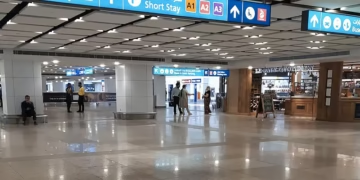
















Dubai is preparing for a major transformation in the way passengers move through airports, with the future of travel increasingly focused on technology, automation and the removal of traditional airport queues.
At the centre of that vision is Al Maktoum International Airport at Dubai World Central, which is being developed to eventually handle up to 260 million passengers a year, making it the world’s largest airport by capacity when fully operational.
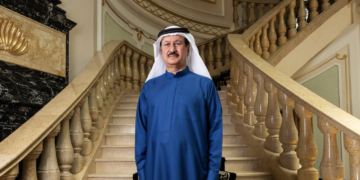
Dubai Airports CEO Paul Griffiths has outlined a future in which passengers could potentially buy a ticket, arrive at the airport, drop off their luggage and proceed almost directly to their departure gate without repeatedly stopping for passport checks, conventional check-in or intrusive security procedures.
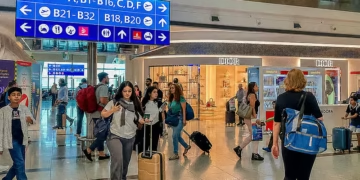
Dubai wants airport queues to disappear
The proposed passenger experience is built around a simple principle: much of the airport process should happen before travellers reach the terminal.
Passenger information could be captured when a ticket is purchased, allowing airport systems to identify travellers automatically when they arrive.
Facial recognition technology, combined with cameras positioned throughout airport facilities, could allow passengers to move through different stages of the journey without repeatedly presenting documents.
The objective is not simply to make airports more technologically advanced, but to make the airport experience feel less like a series of checkpoints.
Griffiths has described the concept as effectively removing the traditional check-in process, allowing passengers to spend less time completing formalities and more time using the facilities available to them.
No more traditional baggage tags?
Baggage handling is another area where Dubai Airports is looking to introduce significant changes.
Traditional paper baggage tags could eventually give way to more advanced digital identification systems, giving each suitcase a unique identity that can be tracked through the airport network.
The idea would allow airport operators to know where luggage is during the journey while reducing the need for passengers to deal with conventional baggage processes.
The broader objective is to make baggage collection and processing happen almost invisibly from the passenger’s perspective.
Dubai Airports is also working on systems designed to have luggage processed more efficiently, potentially reducing the time travellers spend waiting for their bags.
Airport security could become less intrusive
Security screening is another major focus of the transformation.
New-generation screening equipment being introduced at Dubai International Airport is designed to reduce the need for passengers to remove laptops and liquids from their hand luggage.
The next stage of the vision involves making security screening itself less disruptive.
Instead of lifting bags onto elevated conveyor systems and waiting for the screening process to finish, future airport designs could allow passengers to place their hand luggage on lower, easier-to-use systems while continuing to move through the checkpoint.
The goal is to combine passenger movement and security screening rather than treating them as separate stages.
Technology could increase airport capacity
One of the most significant arguments behind the frictionless-airport model is its potential effect on capacity.
If passengers can complete airport procedures in substantially less time, terminals could process more people without necessarily requiring an equivalent expansion of physical infrastructure.
For Dubai, that could become increasingly important as passenger numbers continue to grow.
Reducing waiting times could also create commercial benefits. Travellers who spend less time in queues would have more opportunity to visit shops, restaurants and other airport facilities.
That creates a model in which improved passenger convenience could also translate into stronger commercial activity for airport operators and businesses.
Rail connections could take passengers closer to the gate
The vision extends beyond the terminal itself.
Dubai Airports is discussing the possibility of integrating seamless passenger processing with rail connections serving the airport, potentially allowing travellers to move from a train directly into airport facilities without encountering the conventional sequence of queues and checkpoints.
The long-term ambition is for passengers to reach lounges, restaurants and retail areas close to their departure gates rather than spending large portions of their journey navigating crowded terminal corridors.
Such integration would become particularly important as Al Maktoum International Airport expands toward its eventual capacity.
Al Maktoum International set for a new era
Dubai International Airport, one of the world’s busiest aviation hubs, is eventually expected to transfer its operations to Al Maktoum International.
The first phase of the new airport is scheduled to begin operations in 2032, according to Dubai Airports.
The project is being designed on a scale that will fundamentally change Dubai’s aviation infrastructure, with an eventual capacity of up to 260 million passengers annually.
That scale also presents a challenge: moving hundreds of millions of passengers efficiently cannot depend solely on adding more counters, lanes and traditional infrastructure.
Automation and biometric identification are therefore expected to play an increasingly important role.
A different idea of the airport experience
Dubai’s airport strategy reflects a wider shift taking place across global aviation.
For decades, travellers have generally accepted check-in counters, passport controls, baggage tags, security queues and boarding procedures as unavoidable parts of flying.
The emerging model challenges that assumption.
Instead of asking passengers to adapt to the airport’s processes, Dubai’s approach aims to make technology work around the passenger.
If that vision is successfully implemented, the airport could become less about waiting and processing and more about moving seamlessly from arrival to departure.
For Dubai, which has built its international reputation around connectivity and aviation, that could represent the next major step in its evolution as a global travel hub.