

















Dubai: For entrepreneurs, choosing where to establish a startup can be almost as important as choosing what business to build. Access to capital, international markets, talent, infrastructure, regulation and taxation can determine how quickly a young company moves from an idea to a scalable business.
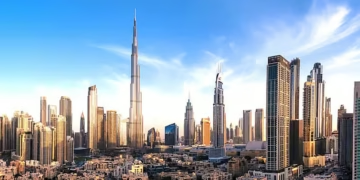
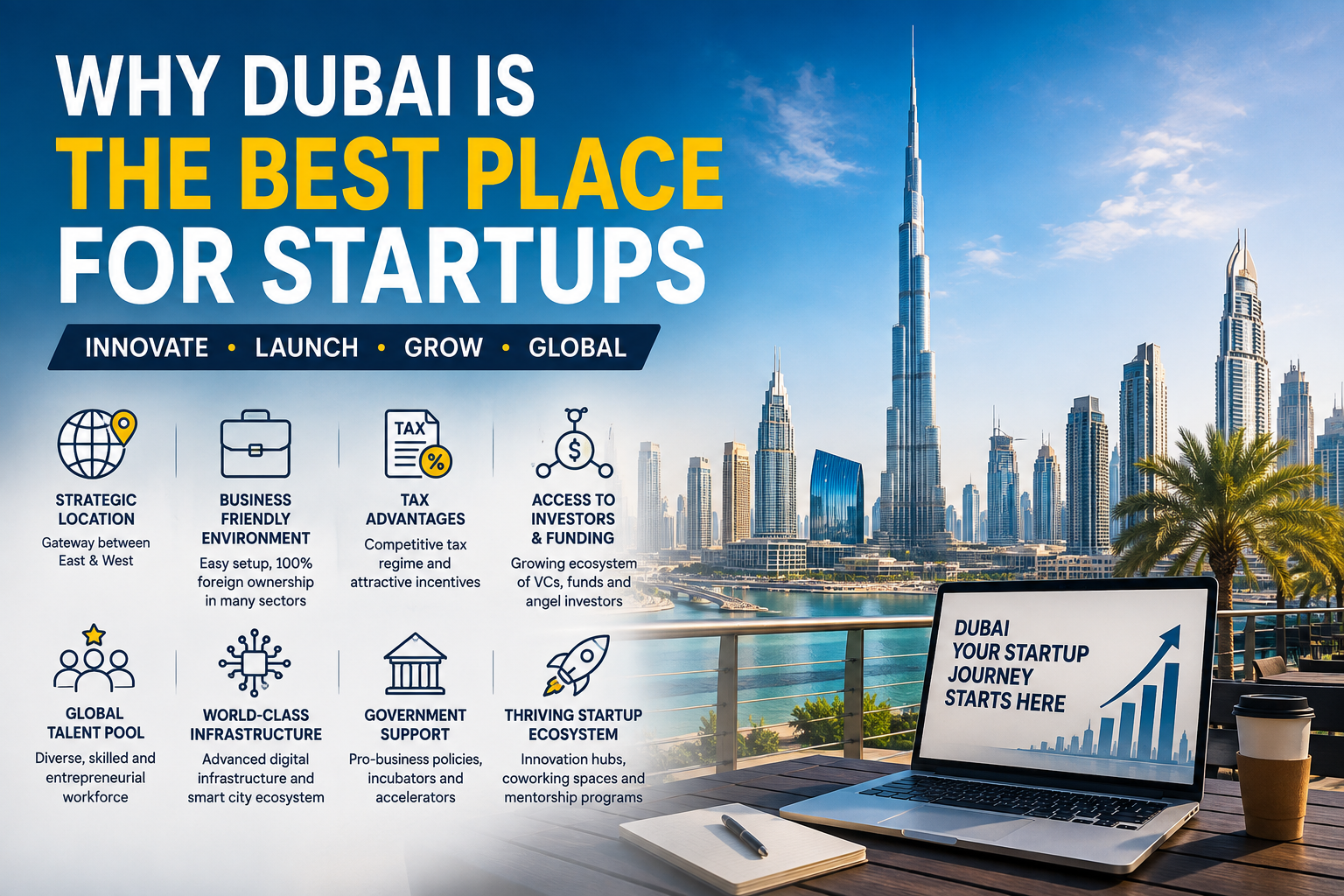
In recent years, Dubai has increasingly positioned itself as a destination for founders looking to build businesses with a regional and global outlook. Its combination of business-friendly policies, international connectivity, specialized free zones, technology ecosystems and access to investors has made the city particularly attractive to startups.
Dubai’s own government describes the emirate as a global business hub offering business setup options, free zones, incubators, digital commerce tools and founder-support initiatives.
A Business Environment Designed for Entrepreneurs
One of Dubai’s strongest advantages is the range of structures available to entrepreneurs.
Founders can choose between mainland and free-zone establishments depending on their business activity and target market. Dubai’s free zones are designed around specific industries and generally provide dedicated business support and streamlined setup processes.
For international founders, ownership is another significant consideration. The UAE allows investors of different nationalities to establish and fully own companies in many sectors, while free zones can offer up to 100% foreign ownership.
That flexibility can be particularly valuable for founders who want to retain greater control over their companies while expanding into the Middle East.
A Tax Structure That Can Support Growth
Taxation is another factor behind Dubai’s appeal, although it is important to understand the current rules rather than simply describing the UAE as a “tax-free” economy.
The UAE’s corporate tax regime generally applies a 0% rate to taxable income up to AED 375,000 and a 9% rate above that threshold. Qualifying Free Zone Persons can potentially benefit from a 0% corporate tax rate on qualifying income, provided they satisfy the applicable requirements.
For startups, the significance is straightforward: the regulatory and tax structure can provide founders with different options for managing their businesses depending on their activities, jurisdiction and revenue model.
However, the benefits are not automatic. Free-zone companies must meet specific conditions, and income that does not qualify for the preferential regime can be subject to the standard corporate tax rules.
Access to International Markets
Dubai’s geographic position gives startups another strategic advantage.
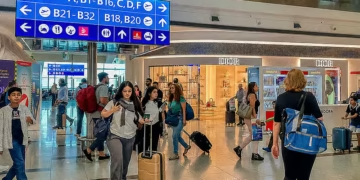
The city sits between major markets across the Middle East, Africa, Asia and Europe, making it a natural base for companies that want to operate across borders.
For a startup, this matters because the address of the company is not merely a legal detail. It can influence access to customers, partnerships, investors and regional business networks.
A technology company headquartered in Dubai, for example, can potentially use the city as a base while targeting customers across the wider GCC and international markets.
A Growing Technology and Innovation Ecosystem
Dubai’s startup story is increasingly connected to technology.
The DIFC Innovation Hub has developed a large ecosystem around fintech and emerging technologies. According to DIFC, the Innovation Hub is home to more than 1,670 innovation and technology firms, including growth-stage technology companies, digital labs, venture capital firms, regulators and educational institutions.
The ecosystem also provides accelerator programmes, innovation-focused licensing, coworking facilities and connections with international technology companies.
For founders working in areas such as fintech, artificial intelligence, SaaS, financial services, Web3 and other technology-driven sectors, being surrounded by companies working on similar problems can create opportunities for partnerships, talent acquisition and investment.
Investors and Capital Are Part of the Ecosystem
Building a startup requires more than a good product. For companies looking to scale rapidly, access to capital can be critical.
Dubai has developed an increasingly sophisticated investment ecosystem around startups and technology businesses. DIFC, for instance, highlights the presence of venture capital firms, family offices and institutional capital within its innovation ecosystem.
DIFC also points to the Dubai Future District Fund, established to attract global and regional capital and support the digitisation of economies across the region.
This creates an environment where founders can potentially move beyond bootstrapping and connect with investors, accelerators and corporate partners.
Infrastructure That Matches Global Ambitions
A startup may begin with a laptop and a small team, but scaling requires reliable infrastructure.
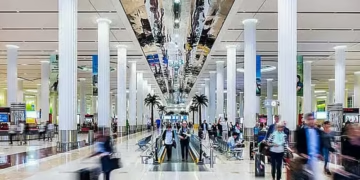
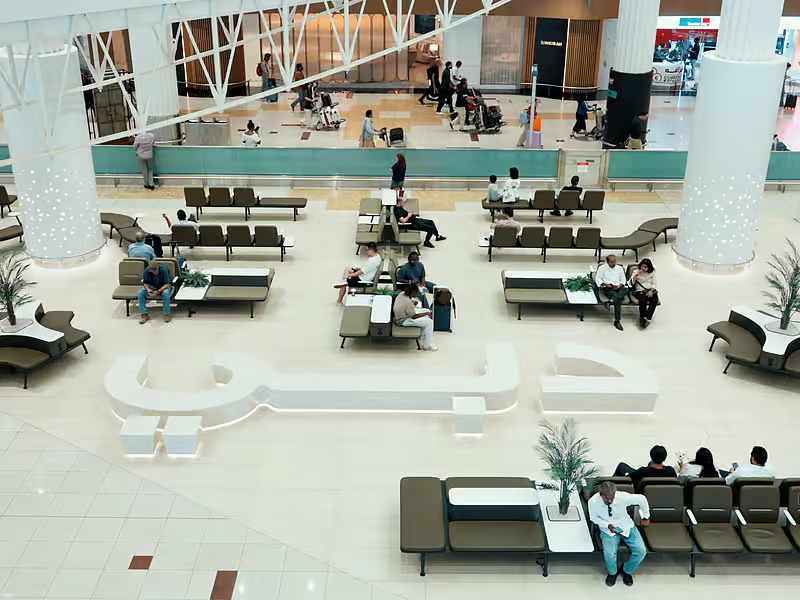
Dubai has invested heavily in digital connectivity, transport, commercial real estate and business infrastructure. Its ecosystem includes coworking spaces, business centres, accelerators and specialized innovation hubs.
For international founders, this infrastructure also reduces some of the friction associated with running a company across borders.
The city’s free zones offer options ranging from flexible office facilities to specialized business infrastructure, with setup services varying according to the chosen zone and activity.
A City Built Around Global Talent
Startups need people as much as they need capital.
Dubai’s international population creates a business environment where founders can interact with professionals from different industries and countries. For companies serving international customers, this diversity can also be useful when building sales, marketing, technology and operations teams.
The ability to bring together people with different market experiences can be particularly important for startups that intend to expand beyond the UAE.
Government Support and a Pro-Business Mindset
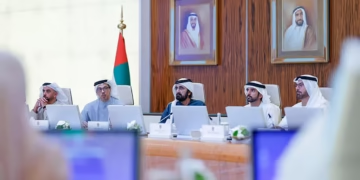
Perhaps the most important reason Dubai continues to attract entrepreneurs is the role of government in shaping the business environment.
Dubai’s official startup resources highlight incubators, founder-support programmes, training, funding and mentorship opportunities. Dubai Founders HQ, for example, is positioned as a platform providing entrepreneurs with access to mentorship, funding and training.
The UAE’s Ministry of Economy and Tourism also identifies startups and SMEs as important components of its investment strategy and highlights measures intended to reduce barriers to investment.
For entrepreneurs, this creates a different experience from markets where founders must navigate fragmented systems with limited institutional support.
Why Dubai Makes Sense for a Global Startup
Dubai may not be the right location for every startup. The cost of operating in the city, the choice of business jurisdiction, licensing requirements and sector-specific regulations all need to be considered before incorporation.
But for founders seeking an international base, Dubai offers a compelling combination: global connectivity, flexible business structures, foreign ownership opportunities, a growing technology ecosystem, access to capital, modern infrastructure and a government actively focused on entrepreneurship.
The bigger opportunity is not simply to “start a company in Dubai.” It is to use Dubai as a launchpad.
For an entrepreneur from India, Europe, Asia or elsewhere, the city can provide a bridge into the wider Middle Eastern market while maintaining connections with international customers and investors.
That is ultimately what makes Dubai attractive to the modern startup founder. It is not just a place where a company can be registered; it is an ecosystem designed around the idea of building, scaling and taking a business beyond its original market.