





















Dubai International Airport (DXB) is moving towards a more automated passenger journey with plans to expand self-service facilities, advance biometric processing and introduce a streamlined experience for remote departures.
The upgrades are part of a broader push by Dubai Airports to reduce queues, improve passenger movement and make the travel experience more comfortable at one of the world’s busiest international aviation hubs.
As travellers increasingly adopt digital and contactless technology, DXB is investing in systems designed to reduce reliance on physical documents and traditional airport processes.
DXB Expands Biometric and Facial Recognition Technology
Facial recognition technology is expected to play an increasingly important role in the airport journey at DXB.
The airport already uses biometric processing across several stages, including check-in, immigration, lounge access and boarding. Eligible travellers can also use Smart Gates to clear passport control through facial recognition technology.
The continued expansion of biometrics is aimed at reducing the need for passengers to repeatedly present passports and boarding passes as they move through the airport.
The wider shift towards a touchless travel experience is also visible at Terminal 3, where Emirates has invested Dh85 million in more than 200 biometric cameras.
Dubai has also introduced its AI-powered Red Carpet immigration corridor, capable of processing up to 10 travellers at the same time without requiring them to stop and present travel documents. Passport control through the system can be completed in as little as six seconds.
More Self-Service Options Planned at Dubai Airport
DXB is also preparing to expand self-service facilities across the airport.
Passengers can already use automated services at selected areas to complete tasks such as:
- Checking in for flights
- Obtaining boarding passes
- Printing baggage tags
- Dropping off checked luggage
The planned expansion could allow more travellers to complete key airport procedures without visiting traditional staffed check-in counters.
While Dubai Airports has not yet detailed the full scope of the additional self-service facilities, the move is expected to support faster passenger processing and reduce waiting times.
DXB Plans a New Remote Departures Experience
Another key part of the airport’s upgrade programme is a new consolidated remote departures experience.
Remote departures involve flights parked at stands away from the terminal, where passengers are generally transported between the terminal and aircraft by bus rather than using an aerobridge.
Currently, passengers on such flights may wait in terminal boarding areas or dedicated holding lounges before boarding buses across the airport apron.
Dubai Airports is now working on a more streamlined approach that could bring more of the process together in a dedicated passenger experience.
However, the airport has not yet confirmed where the new system will be introduced, which terminals or airlines will be involved, or how the final passenger journey will operate.
Smarter Systems to Improve Passenger Movement
Beyond self-service and biometric technology, DXB is introducing smarter operational systems and targeted upgrades across key passenger areas.
The improvements are focused on:
- Making airport spaces easier to navigate
- Improving passenger flow
- Reducing bottlenecks
- Increasing operational flexibility
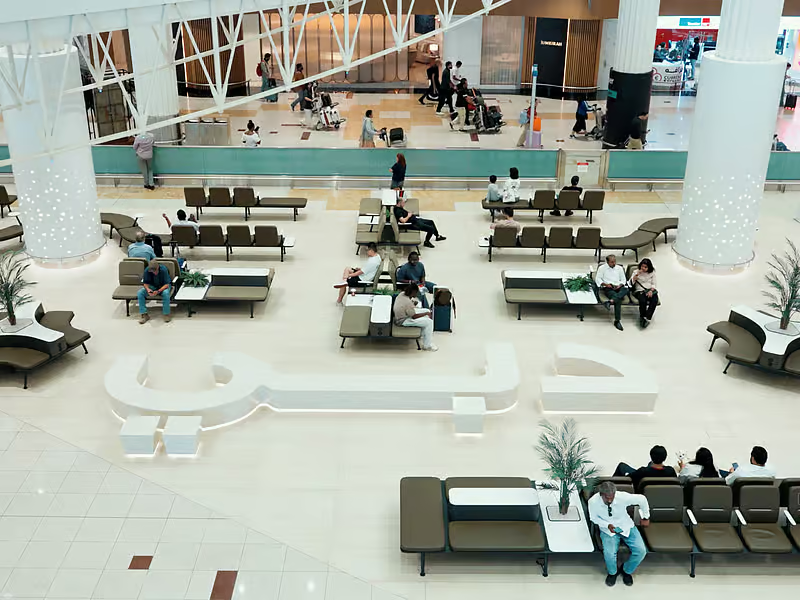
- Enhancing the comfort of waiting areas
The combination of technology and infrastructure changes is intended to help the airport handle passenger movement more efficiently as traffic continues to recover.
Travellers Increasingly Support Digital Airport Technology
DXB’s plans reflect a wider shift in how travellers want to move through airports.
According to IATA’s 2025 Global Passenger Survey, 50 per cent of travellers had already used facial recognition during part of their journey.
The survey also found that 74 per cent of passengers were willing to share biometric data if it meant avoiding repeated passport or boarding-pass checks.
Meanwhile, 78 per cent said they wanted a single smartphone-based solution that could combine digital passports, payments and loyalty credentials.
These preferences are helping drive the aviation industry’s move towards a more connected, digital and document-light travel experience.
DXB Passenger Traffic Shows Signs of Recovery
The airport’s investment programme comes as DXB continues its recovery from a difficult first half of 2026.
Dubai International welcomed 31.5 million passengers during the first six months of the year, a decline of 31.3 per cent compared with the same period in 2025.
However, monthly passenger traffic improved through the second quarter.
Traffic increased from 3.5 million passengers in April to 5 million in June, pointing to a gradual recovery in airport activity.
By the end of June, almost 50 international airlines were operating at DXB, connecting travellers to 217 destinations across 99 countries.
What’s Next for Dubai International Airport?
Dubai Airports expects passenger traffic to gain further momentum in the second half of 2026 as airline networks and flight frequencies return.
A rise in international transfer traffic, the start of the winter travel schedule and Dubai’s calendar of major business, leisure and sporting events are also expected to support the recovery.
The latest technology upgrades signal a longer-term transformation at DXB, where the traditional airport experience could increasingly be replaced by facial recognition, automation, digital credentials and self-service technology.
For passengers, that could mean fewer queues, fewer document checks and a faster journey from check-in to boarding.