


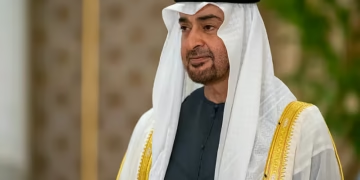




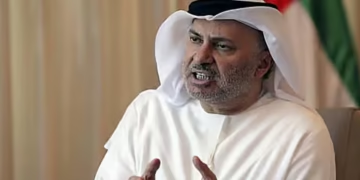























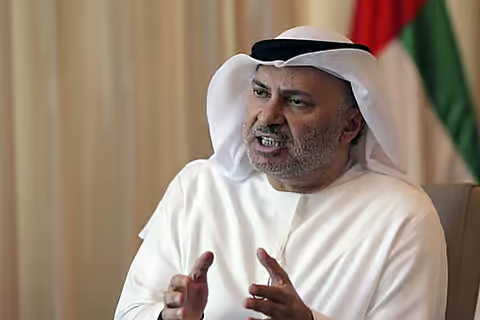
UAE diplomatic adviser Dr Anwar Gargash has criticised what he described as targeted media campaigns against the UAE, saying the country would remain focused on its development and achievements amid heightened regional tensions.
In a post on X on Saturday, Gargash described the campaigns as “desperate” and accused those behind them of relying on what he characterised as distortion and rumours.
“The principle is that action is stronger than reaction,” Gargash said, arguing that efforts to undermine what he called a successful UAE model would not change the country’s course.
His remarks come as the Middle East continues to face heightened uncertainty amid the ongoing US-Iran conflict, economic pressure on Tehran and disputes surrounding shipping through the strategically important Strait of Hormuz.
Gargash rejects criticism of the UAE
Gargash said the UAE had become the target of campaigns that, in his view, sought to portray the country negatively.
He said such efforts were based on distortion and rumours rather than facts, adding that confronting a successful development model was difficult for those attempting to undermine it.
He also questioned the resources being spent on such campaigns, suggesting that they could instead have been directed towards constructive development.
The comments were made as governments across the region continue to monitor the wider consequences of the US-Iran conflict, including security concerns, disruptions to trade and pressure on energy markets.
Strait of Hormuz remains a major point of tension
The dispute over the Strait of Hormuz has emerged as one of the central issues in the regional crisis.
US President Donald Trump has repeatedly said the waterway remains open. Iran’s Revolutionary Guards Corps Navy, however, has rejected that claim and said restrictions on shipping would remain in place until US military actions against Iran end and related commitments are implemented.
According to preliminary shipping data cited in the supplied reports, only seven commodity vessels crossed the strait on Thursday, compared with 17 the previous day and a 10-day average of 15.
The figures highlight the continued uncertainty surrounding one of the world’s most important energy shipping routes.
The United States has also said its forces cleared sea mines from the waterway that had allegedly been placed months earlier by Iran’s Islamic Revolutionary Guard Corps.
Iran acknowledges growing economic pressure
The conflict is also placing increasing pressure on Iran’s economy.
Iranian President Masoud Pezeshkian has acknowledged that US sanctions and wartime conditions are affecting trade, saying the country’s exports and imports had fallen by between 25% and 35% in recent months.
Iranian officials have also said the government is focusing on inflation, employment, market management and domestic production as it attempts to withstand the economic impact of sanctions and the conflict.
Iran’s government said Saturday that it would continue resisting what it called unjust sanctions while keeping the possibility of diplomacy with Washington open.
It described diplomacy and defence as complementary tools for protecting Iran’s national interests, security and territorial integrity.
The statements indicate that Tehran is seeking to maintain its position on the conflict while also addressing mounting economic challenges at home.
Diplomatic efforts continue despite tensions
While Washington has indicated that it is not currently seeking direct talks with Tehran, diplomatic efforts involving regional countries are continuing.
Qatar’s Prime Minister Sheikh Mohammed bin Abdulrahman Al Thani travelled to Tehran and held discussions with Iranian officials as part of efforts to revive stalled diplomacy.
Qatar has urged a return to open shipping through the Strait of Hormuz, while Iranian Foreign Minister Abbas Araghchi described the discussions as constructive.
Qatar and Pakistan had previously played a role in efforts that produced a short-lived ceasefire, although disagreements over the strategic waterway subsequently contributed to the breakdown of that arrangement.
The latest diplomatic contacts suggest that regional governments continue to see negotiations as an important route towards reducing tensions, even as military and economic pressure remains high.
Hezbollah rejects Lebanon-Israel agreement
The wider crisis is also affecting Lebanon.
Hezbollah leader Naim Qassem has again rejected an agreement between Lebanon and Israel, saying the Iran-backed group would not accept what he described as surrender.
In a televised address, Qassem called for the framework agreement to be rejected.
His comments came almost six months after fighting between Israel and Hezbollah escalated, adding another layer of uncertainty to efforts aimed at securing a lasting regional settlement.
The situation in southern Lebanon remains tense, with Lebanon’s state-run National News Agency reporting Israeli airstrikes in the south, including in the Nabatieh area.
US prepares further military deployment
The United States is also expected to strengthen its military presence in the region.
The USS Theodore Roosevelt is expected to deploy to the Middle East in the coming weeks for a deployment lasting at least seven months, according to reports cited in the supplied material.
The move comes as the US military manages increasing demands linked to the conflict.
More than 50,000 US troops are stationed across the region, while additional Marines and sailors have reportedly been deployed to support operations.
The prolonged conflict has also affected American military families, with reports describing months of uncertainty as service members remain deployed in the Middle East.
Washington faces economic and political pressure
The conflict is creating challenges for the US administration at home as well.
Rising energy prices have increased concerns about the economic impact of the war on American consumers, while the approach to Iran is becoming an increasingly significant political issue ahead of the November congressional elections.
The Trump administration has intensified its sanctions campaign against Tehran and warned countries against continuing business with Iran.
However, aggressive enforcement could put Washington in a difficult position with major Iranian trading partners, including China and India.
US Senator Jack Reed has criticised the administration’s handling of the conflict, arguing that the war had failed to achieve its stated objectives and had weakened the US position internationally.
Venezuela emerges in US energy strategy
The conflict has also coincided with a major US push involving Venezuela’s oil resources.
Trump has announced an unprecedented effort aimed at securing greater US control over part of Venezuela’s extensive oil reserves, with the stated objective of increasing crude supplies and easing pressure on American fuel prices.
Venezuela’s interim leader Delcy Rodriguez said an agreement could support increased production through the development of 17 strategic oil fields and generate significant tax revenue for the country.
The move reflects the broader impact of the Iran conflict on global energy markets and the growing importance of alternative sources of crude.
Regional tensions remain fluid
The UAE’s response comes against a rapidly changing regional backdrop involving military confrontation, sanctions, energy markets and renewed diplomatic initiatives.
For Gulf countries, developments surrounding the Strait of Hormuz remain particularly important because of the waterway’s role in global energy transportation and regional trade.
At the same time, governments are balancing security concerns with economic priorities and efforts to preserve regional stability.
Gargash’s comments reflect the UAE’s broader emphasis on maintaining its development agenda despite the instability surrounding the country.
As diplomatic efforts continue alongside military and economic pressure, the region remains at a critical juncture, with the possibility of further escalation existing alongside renewed attempts to bring the conflict back towards negotiations.