
































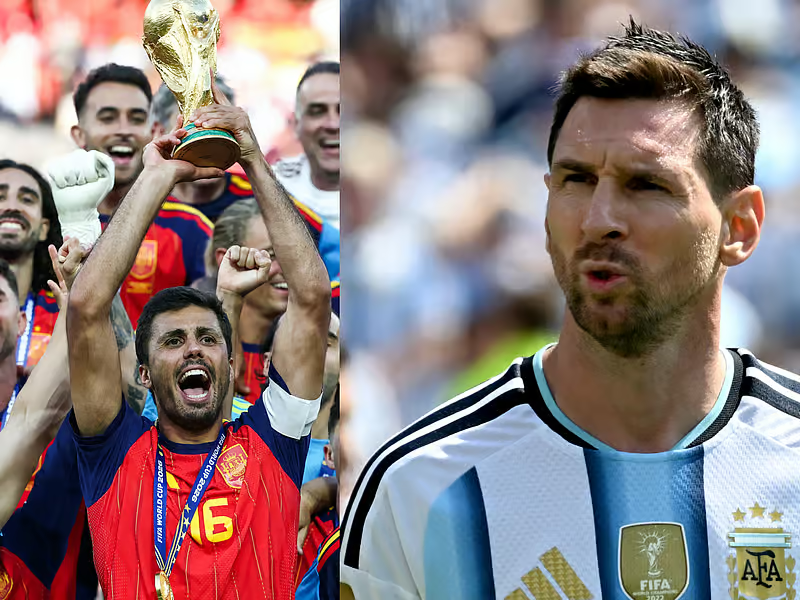
Lionel Messi’s international career is inseparable from Argentina. The blue-and-white shirt, the captain’s armband and the World Cup triumph in Qatar have become defining images of one of football’s greatest careers.
But there was a time when Messi could have been wearing Spain’s colours instead.
As Messi announced his retirement from international football, an intriguing chapter from his teenage years resurfaced: Spain tried to convince the young Barcelona prospect to represent the country, while Argentina’s football authorities were initially unaware of the extraordinary talent developing in Spain.
In the end, a remarkably old-fashioned method helped change the course of international football.
Argentina found Messi through a phonebook.
Messi’s journey from Rosario to Barcelona
Messi was born in Rosario, Argentina, and moved to Spain at the age of 13 for a trial with Barcelona.
His family had been struggling to afford treatment for his growth hormone deficiency, a medical condition that threatened to prevent him from developing normally.
The family had initially sought help from Argentine clubs.
Newell’s Old Boys, where Messi was already playing in the youth system, had been approached for assistance. River Plate was also contacted, but neither club ultimately provided the support the family needed.
That led the Messi family to consider a move to Spain, where Barcelona offered the youngster an opportunity that would eventually transform football.
During his trial, Messi immediately made an impression. Playing against older and physically bigger boys, he scored five goals and convinced Barcelona’s youth coaches of his extraordinary ability.
Barcelona eventually signed him and agreed to take responsibility for his treatment.
Spain noticed Messi before Argentina did
Messi’s progress through Barcelona’s youth ranks was rapid.
His performances attracted attention from the Spanish football authorities, who saw an opportunity to secure one of the most promising young players in the country.
Spain began exploring the possibility of convincing Messi to represent the national team.
For the Messi family, however, the answer was clear.
Despite living and developing as a footballer in Spain, the teenager remained committed to representing Argentina, the country where he was born.
There was just one problem: Argentina’s football authorities did not appear to know enough about the young star who was making waves in Barcelona.
The Spanish passport did not change Messi’s mind
Spain continued its efforts even as Messi remained committed to Argentina.
The teenager eventually received a Spanish passport in 2005, but citizenship did not persuade him to change his international allegiance.
Former Spain coach Vicente del Bosque later acknowledged that the federation had made efforts to recruit Messi.
The possibility of Messi playing for Spain remains one of football’s great what-ifs.
Spain’s golden generation went on to win the 2010 World Cup and the 2012 European Championship. Had Messi joined that team, international football history could have looked dramatically different.
But Messi never abandoned his ambition to play for Argentina.
Argentina finally discovers its teenage superstar
The situation changed when Argentine football officials learned about Messi’s performances for Barcelona.
After watching a VHS recording of his matches, officials realised that Argentina could not afford to lose such a rare talent.
Omar Souto, a former manager of the Argentina national team, was tasked with finding Messi’s family.
The challenge was surprisingly difficult.
Rather than using modern databases or digital searches, Souto reportedly turned to a phonebook.
He searched through the names of people called Messi in Rosario, contacting one after another until he eventually reached Messi’s paternal grandmother.
She then connected him with Messi’s uncle, allowing Argentine officials to establish contact with the family and, eventually, with Messi’s father, Jorge.
That phonebook search became an unlikely turning point in the story of Argentine football.
Messi makes his Argentina debut
Once contact had been established, Argentina moved quickly.
The country’s football association arranged a friendly match against Paraguay’s Under-20 team in June 2004.
It marked the beginning of Messi’s journey with Argentina’s national teams.
The following year, Messi helped Argentina win the 2005 Under-20 World Cup.
The tournament also produced an intriguing encounter with Spain, the country that had tried to recruit him.
Argentina defeated Spain 3-1 in the quarterfinal, with Messi scoring his team’s third goal.
What if Messi had chosen Spain?
The question has fascinated football fans for years.
Spain’s national team of the late 2000s and early 2010s was one of the strongest international sides ever assembled. The team dominated possession-based football and won the 2008 European Championship, 2010 World Cup and 2012 European Championship.
Messi, at the height of his powers, could have added another extraordinary dimension to that squad.
Some believe Spain could have become even more dominant with him in the team.
For Argentina, however, the decision had an entirely different meaning.
Messi’s international career became intertwined with years of heartbreak before reaching its ultimate reward.
From international heartbreak to World Cup glory
For much of his career, Messi faced intense pressure to deliver an international trophy with Argentina.
There were defeats in major finals, criticism over his performances and periods when his future with the national team appeared uncertain.
Yet he continued to return.
The breakthrough eventually came at the 2021 Copa América, when Argentina defeated Brazil to win a major senior international title with Messi at the centre of the team.
A year later came the defining achievement.
Argentina won the 2022 FIFA World Cup in Qatar, with Messi scoring twice in the final against France and eventually lifting the trophy after a dramatic penalty shootout.
For a player who had spent much of his career being compared with Argentina legend Diego Maradona, the triumph provided the international validation that had eluded him for so long.
A strange full-circle moment
Messi’s connection with Spain became even more symbolic years later.
The country that had once tried to persuade him to play for its national team eventually faced him on football’s biggest stage.
The 2026 World Cup final between Argentina and Spain added another remarkable twist to the story.
It also came amid renewed attention on the famous photograph of a young Messi holding baby Lamine Yamal during a Barcelona charity photoshoot.
The image, taken more than 18 years ago, showed an extraordinary overlap between two generations of football talent.
Yamal would later emerge as one of Spain’s biggest stars, while Messi became Argentina’s defining player of his generation.
The phonebook that changed football history
It is impossible to know how international football would have developed if Argentina had failed to locate Messi.
Perhaps Spain’s golden generation would have included him. Perhaps Argentina would have discovered him later. Or perhaps the trajectory of his career would have been completely different.
What is certain from this story is that Argentina’s discovery of its future superstar did not begin with an elaborate scouting network.
It began with a phonebook.
A search through ordinary names in Rosario connected Argentine football officials with a teenager whose career would eventually include multiple Ballon d’Or awards, major club records, Copa América glory and a World Cup triumph.
Spain saw Messi’s talent early.
Argentina nearly missed him.
But once the phone call was finally made, one of football’s greatest international stories had begun.