

































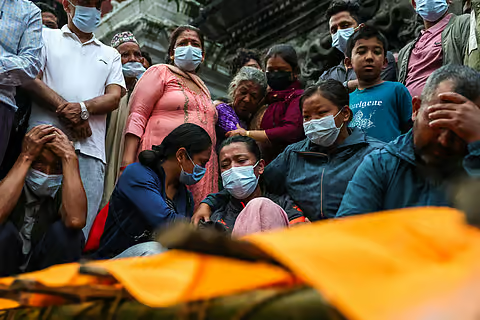
Nepal is facing one of its most devastating natural disasters in recent years, with the death toll from catastrophic floods rising to 1,204 and another 4,216 people reported missing, according to the country’s disaster authorities.
The floods struck on August 26 after a glacial collapse near the Nepal-China border unleashed a powerful surge of water, rock, mud and debris through mountainous communities. The disaster destroyed homes, roads, bridges and critical infrastructure across several affected areas.
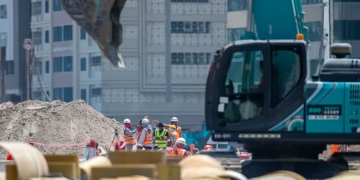
As the search enters a critical phase, rescue teams are focusing on damaged hydropower facilities where workers are believed to remain trapped inside underground tunnels.
Rescue Teams Race to Reach Trapped Workers
Search operations have increasingly shifted towards hydropower projects, where authorities believe some missing workers may have survived inside underground chambers.
Officials said 639 people connected to hydropower projects remained missing, while 279 had already been rescued from affected sites. At the Rasuwagadhi hydropower project, authorities said they believed 46 workers could be trapped inside a tunnel structure where food and water may still be available.
Rescuers are facing major obstacles, including collapsed tunnel entrances, heavy mud, unstable terrain and large quantities of debris. Nepalese, Indian and Chinese teams are working alongside local authorities in an effort to locate survivors.
Despite the difficult conditions, officials have continued searching areas where there is still a possibility of finding people alive.
Thousands of People Still Unaccounted For
The scale of the disaster has made identification and recovery particularly challenging. Authorities have been working to identify recovered bodies, with forensic specialists using DNA profiling to help families determine the fate of missing relatives.
China has also said it will send additional DNA identification experts and emergency supplies to Nepal. The assistance is part of a wider international response to the disaster.
Among those listed as missing are foreign nationals, including Nepali, Indian and Latvian citizens. Many Indian nationals were in the region as pilgrims visiting Lake Mansarovar and Mount Kailash in Tibet.
India and Other Nations Step Up Assistance
International assistance has expanded as Nepal struggles with the scale of the destruction.
India sent its fifth aircraft carrying an 11-member specialised rescue team, equipment and 5.5 tonnes of essential medicines. China has deployed rescue resources and announced additional emergency assistance.
The United States also provided disaster-response equipment, including thousands of victim-recovery supplies, first-aid kits, stretchers and heavy machinery. Washington said the latest assistance was in addition to previously announced funding for Nepal’s flood response.
South Korea and Singapore have also contributed specialised teams, including personnel involved in emergency relief and victim identification.
Roads and Bridges Swept Away
The floods caused extensive damage to Nepal’s already challenging mountain infrastructure.
The United Nations Development Programme estimated that the disaster generated approximately 2.2 million tonnes of debris, including rocks, sediment and destroyed structures.
The country’s electricity infrastructure was also badly affected. Eight existing hydropower projects and four projects under construction were damaged, with officials warning that some may not be repairable.
Nearly 50 suspension bridges were damaged, while 31 motorable bridges were washed away. The destruction has made it significantly harder for rescuers and relief workers to reach isolated communities.
Nepal’s finance minister has estimated that the country could require between $4 billion and $5 billion for reconstruction.
Temporary Crossings Help Stranded Survivors
With bridges and roads destroyed, communities have been forced to find alternative ways to cross swollen rivers.
In Bidur, the Nepal Army installed a temporary cable crossing over the Trishuli River. The roughly 250-metre zipline has provided a vital route for residents who need access to medical care, food, medicine and other essential supplies.
The crossing has also become an important link for people separated from their families by the floods.
Focus Begins to Shift Towards Recovery
A week after the disaster, Nepal’s government acknowledged that the chances of finding survivors were declining in some areas.
Prime Minister Balendra Shah said the government’s attention was increasingly turning towards rehabilitation and reconstruction while continuing efforts to protect people in affected communities and provide medical and psychological support.
The enormous amount of debris, damaged infrastructure and isolated settlements means recovery is expected to be a long and difficult process.
Disaster Raises Climate Change Concerns
The Nepal floods have also renewed international concerns over the impact of climate change on vulnerable mountain regions.
Mafalda Duarte, executive director of the UN-backed Green Climate Fund, said disasters such as the Nepal floods and wildfires elsewhere should reinforce the need for greater climate action.
The Hindu Kush Himalaya region is particularly vulnerable to changes affecting glaciers and water systems. The scale of the latest disaster has intensified discussion about the risks facing communities living in mountainous areas.
A Long Road Ahead for Nepal
With more than 1,200 people confirmed dead and thousands still missing, Nepal’s immediate priority remains locating survivors and recovering victims. At the same time, the country faces the enormous task of restoring roads, bridges, electricity facilities and homes.
The international response is providing specialised expertise, equipment and medical supplies, but the destruction across remote mountain communities means recovery will take considerable time.
For families still waiting for news of missing relatives, rescue operations at hydropower tunnels and other difficult-to-reach locations remain a final source of hope. For the wider country, attention is gradually turning towards rebuilding communities devastated by one of Nepal’s most destructive flood disasters.