



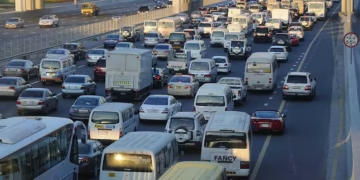



























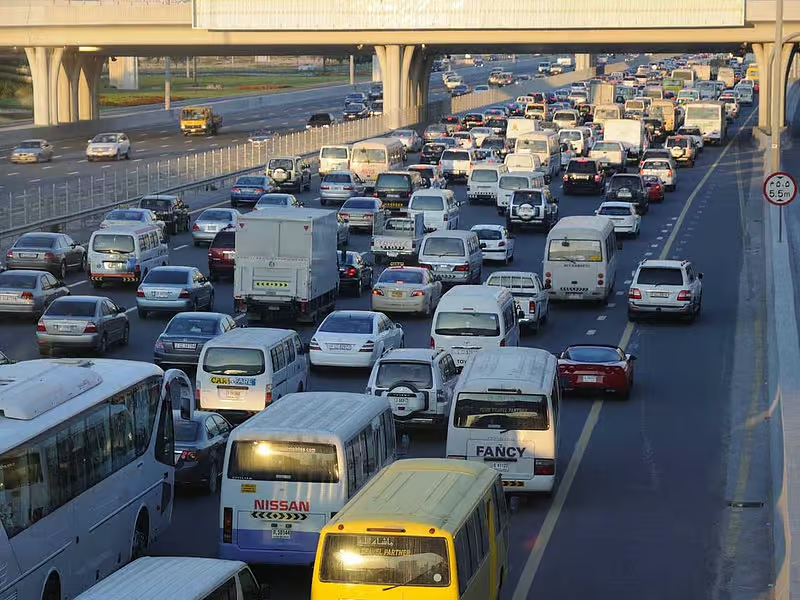
The return of students to classrooms across the UAE has brought back a familiar challenge for motorists: crowded roads and longer school-run journeys.
In Dubai, Ajman and Sharjah, traffic around schools has intensified as families settle into new academic-year routines. Morning drop-offs are proving particularly difficult because school traffic coincides with the broader rush-hour commute, creating queues around school entrances, U-turns and nearby residential communities.
For some parents, journeys that would normally take only a few minutes are stretching considerably longer.
One Dubai parent said his son’s school bus takes about 40 minutes to cover a distance of roughly 2 kilometres after school ends. While multiple student stops contribute to the journey, traffic congestion around school zones is adding another layer of delay for families driving children to and from campus.
Dubai school zones see renewed congestion
The difference has been especially noticeable in communities such as Emirates Hills and Arabian Ranches, where roads become heavily congested during the morning drop-off and afternoon pick-up periods.
Parents say queues begin building around school entrances and nearby turning points, forcing motorists to allow additional time for what would otherwise be short journeys.
The problem is most pronounced during the morning commute. School buses, private vehicles and regular office traffic all converge on the roads within a relatively narrow time window.
In Arabian Ranches, parents have reported an immediate increase in traffic since schools reopened, describing slow-moving vehicles around campuses during peak periods.
For many families, adding extra time to the morning schedule has once again become part of the school routine.
Ajman sees heavier traffic during first week
The return to school has also affected traffic patterns in Ajman.
At Woodlem Park School in Al Jurf, transport officials said the opening week brought heavier-than-usual congestion, particularly when school timings overlapped with office-hour traffic.
However, the situation has shown signs of improvement as parents, students and school staff become familiar with their new schedules.
School transport officials noted that morning drop-off remains more challenging than afternoon pick-up, with the latter generally experiencing smoother traffic conditions.
The expectation is that congestion will gradually ease as families settle into consistent routes and timings.
Private cars add pressure to school roads
The heavy traffic highlights the significant role private vehicles continue to play in the UAE’s daily school commute.
Data from Dubai’s Roads and Transport Authority indicates that about 47 per cent of students travelled to school by private vehicle during the 2025–26 academic year, while around 44 per cent used school buses.
A large majority of parents — about 91 per cent — also reported using designated student drop-off and pick-up areas.
The concentration of vehicles in these areas means even a minor delay can quickly create a longer queue. When hundreds of cars arrive at the same school within minutes of one another, access roads and turning points can become bottlenecks.
Dubai upgrades school-zone roads
Authorities have been working to address some of these problems ahead of the new academic year.
Dubai’s Roads and Transport Authority carried out traffic and road improvements at six school-zone locations during the summer, covering areas including Wadi Al Safa 4, Al Barsha, Umm Al Sheif, Dubai Motor City, Dubai Studio City and Al Sufouh.
The projects were designed to improve traffic movement and strengthen safety around more than 10 schools.
One of the key improvements involved a new road connection between Al Qudra Road and Hessa Street through Dubai Motor City and Dubai Studio City. The route is expected to improve access to GEMS Metropole School and surrounding areas.
At Horizon International School in Umm Al Sheif, parking capacity was increased, while improvements were also made to entrances and exits near the Al Barsha South schools complex.
Traffic measures were also introduced around The International School of Choueifat – Dubai in Al Sufouh and GEMS Winchester School – Dubai in Wadi Al Safa 4.
Sharjah also strengthens school-area roads
Sharjah has undertaken road development and maintenance work in Al Jazzat and Al Hazana as part of efforts to improve traffic flow and road safety.
The work included improvements to asphalt surfaces and the renewal of road markings.
Such upgrades are intended to make roads more efficient while providing safer conditions for motorists, pedestrians, students and school staff.
Drivers urged to take extra care
With children moving through school zones during the busiest parts of the day, motorists are being urged to exercise additional caution.
Drivers should reduce their speed when approaching schools, remain prepared to stop at pedestrian crossings and watch carefully for children moving between parked vehicles.
Parents can also help reduce congestion by following designated drop-off procedures, avoiding unnecessary waiting near school entrances and allowing sufficient time for the journey.
Traffic may ease as routines settle
The first weeks of the academic year typically bring some disruption as families adjust to new school timings, routes and transportation arrangements.
In Ajman, school transport officials expect traffic conditions to become more streamlined in the coming weeks as parents and staff settle into their routines.
For motorists across Dubai, Ajman and Sharjah, however, the immediate message is clear: the school run is once again a major factor in peak-hour traffic.
Planning ahead, leaving earlier and following school-zone safety rules could make the daily commute less stressful — and help keep roads moving during one of the UAE’s busiest periods of the day.