

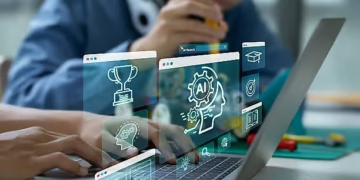
































Schools across the UAE are beginning to put the country’s new artificial intelligence curriculum into practice, introducing students to AI through age-appropriate activities, supervised digital tools and real-world applications.
The rollout marks a significant shift in how technology is being incorporated into education. Rather than treating artificial intelligence simply as another digital skill, schools are increasingly focusing on how students can understand, question and use the technology responsibly.
The UAE has approved an AI curriculum for public and private schools covering key areas including AI data, algorithms, applications, risks and ethics. The national programme is also supported by plans to train around 22,000 teachers and educators in using AI for teaching, assessment, curriculum development and lesson planning.
AI education starts with simple concepts
The approach varies according to students’ age and level of understanding.
At Raffles World Academy in Dubai, AI literacy is being introduced progressively across primary and secondary education. Younger students encounter AI concepts through existing classroom subjects and inquiry-based learning rather than through a separate, technology-heavy programme.
Students may explore how AI is used in areas such as medical diagnosis, experiment with creative digital tools or discuss whether information provided by voice assistants should always be trusted.
As students become older, they are introduced to teacher-supervised platforms and AI features within familiar educational software. The emphasis remains on ensuring that technology assists learning rather than replacing independent thinking.
This approach reflects a growing concern among educators that students need more than the ability to operate AI tools. They also need to understand when those tools can be unreliable and how their output should be evaluated.
Younger children learn AI through play
At JSS Private School Dubai, AI awareness among younger students takes a deliberately low-tech approach.
Instead of relying heavily on screens, teachers use games and classroom activities to introduce basic ideas associated with artificial intelligence.
Children can sort pictures into groups to understand how machines identify patterns or give classmates step-by-step instructions to demonstrate how systems follow commands. Such activities allow students to explore concepts linked to AI without requiring advanced technical knowledge.
Storytelling and supervised digital programmes, including tools such as Scratch Jr, are also being used where appropriate.
For early-years students, the priority is not to teach complex AI systems. Instead, schools want children to understand fundamental ideas about technology, including that machines follow instructions and that digital systems only have access to information provided to them.
Safety is another important part of the discussion.
Students are encouraged to understand why personal information, photographs and other details should not be shared with digital tools without appropriate adult guidance.
AI lessons become more practical for older students
As students move into secondary school, AI education becomes more explicit and increasingly connected to real-world applications.
At Raffles World Academy, older students are introduced to topics including machine learning, neural networks, predictions, ethics and the practical uses of AI.
Platforms such as Code.org are being used to help students move from basic concepts towards a deeper understanding of how AI systems work.
The objective is to develop students who can critically assess artificial intelligence rather than simply use it.
That distinction is becoming increasingly important as AI tools become more common in education, workplaces and everyday life.
Schools put responsibility and ethics at the centre
Educators across the UAE are also stressing that AI should complement human learning rather than replace it.
At Shining Star International School Abu Dhabi, teachers are introducing younger students to carefully selected AI tools under supervision. The school’s approach places responsible use, creativity, curiosity and human interaction at the centre of AI education.
The message is particularly relevant for younger learners, who may not yet have the ability to distinguish between reliable and unreliable information generated by digital systems.
Schools are therefore combining technology lessons with broader skills such as critical thinking, problem-solving and ethical decision-making.
Woodlem Education is taking a similar approach, with students expected to develop digital literacy alongside creativity, problem-solving and responsible use of AI.
The school is also focusing on teacher training and encouraging AI-related projects, competitions and challenges to give students opportunities to experiment with emerging technology in structured environments.
Could AI make classrooms more personalised?
Beyond teaching students about artificial intelligence, some UAE schools are exploring how AI itself could change the classroom experience.
At Dubai International Academy – Emirates Hills, educators see potential for AI-powered learning software to track student progress and respond to individual needs.
Such systems could identify areas where a student is struggling and provide additional lessons or exercises designed around those gaps. Students who demonstrate stronger understanding could, meanwhile, progress through material at a faster pace.
The idea points towards a more personalised model of education in which technology supports teachers by identifying learning needs and helping students receive targeted assistance.
However, educators continue to stress that technology is intended to support—not replace—the role of teachers.
A long-term shift in UAE education
The UAE’s AI curriculum represents more than the introduction of another subject in schools. It signals a broader effort to prepare students for an economy and society increasingly shaped by artificial intelligence.
For younger children, that preparation may begin with games, stories and discussions about how machines work. For older students, it can develop into lessons on machine learning, neural networks, ethics and real-world applications.
Teacher training will remain an important part of the transition. With thousands of educators expected to receive AI-related training, schools will need to ensure that teachers are equipped not only to use new tools but also to guide students in understanding their limitations.
The ultimate goal is emerging as a balanced one: giving students the confidence to use AI while ensuring they retain the human skills needed to question, evaluate and make decisions about what technology produces.
As the curriculum continues to take shape across UAE schools, classrooms are likely to become an important testing ground for how the next generation learns to work alongside artificial intelligence.