



























Dubai: Fresh uncertainty has emerged over the future of US-Iran diplomacy after US President Donald Trump announced that negotiations with Tehran would restart this week. Iranian officials, however, have firmly rejected the claim, insisting that no direct talks with Washington are currently taking place.
The conflicting statements come at a time when regional tensions remain elevated following months of military confrontations involving the United States, Israel and Iran. At the heart of the dispute is the Strait of Hormuz, one of the world’s most strategically important maritime routes and a critical artery for global energy supplies.
Trump Claims Diplomatic Breakthrough Is Within Reach
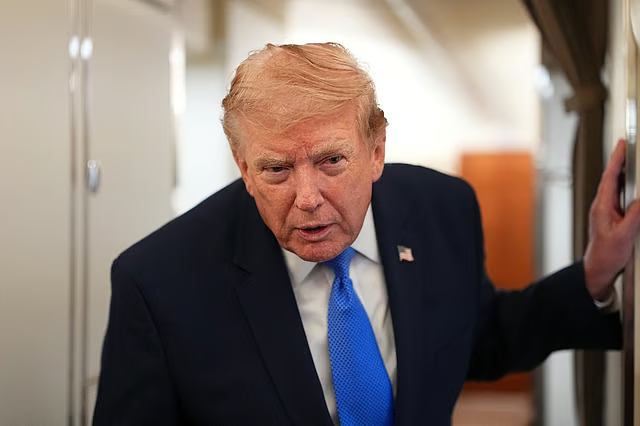
Speaking to reporters aboard Air Force One, President Trump said discussions with Iran were expected to begin on Monday afternoon. According to him, the proposed negotiations would primarily focus on securing uninterrupted passage through the Strait of Hormuz and addressing Iran’s nuclear programme.
Trump also claimed that military action against Iran had been under serious consideration but was ultimately delayed after consultations with regional allies who favoured a diplomatic approach. He suggested that an agreement involving both maritime security and nuclear issues could be achieved in the near future.
The US President further indicated that key Gulf partners had expressed concerns that another large-scale military operation could destabilise the region and preferred negotiations over escalation.
Iran Rejects Reports of Direct US Talks
Tehran responded quickly to Trump’s remarks, dismissing suggestions that negotiations with the United States had resumed.
Iranian Foreign Ministry spokesperson Esmail Baghaei stated that no official meetings or delegations involving Washington are planned at present. Instead, he said Iran is engaged in discussions with Oman to establish a temporary maritime corridor aimed at facilitating safer commercial navigation through the Strait of Hormuz.
According to Baghaei, talks with Omani officials have made gradual progress over the past week. However, he cautioned that any temporary arrangement should not be interpreted as a full reopening of the waterway.
He also reiterated that Iran’s position would remain unchanged if what he described as continued US military pressure persists.
Oman Continues Mediation Efforts
Oman has once again emerged as a key diplomatic intermediary between regional stakeholders.
Iranian officials confirmed that Muscat is working with Tehran to explore practical solutions that could allow commercial vessels to transit safely through parts of the Strait while broader political disagreements remain unresolved.
Baghaei also acknowledged that countries including Pakistan and Qatar continue to play diplomatic roles in efforts to reduce tensions, while China remains actively engaged in encouraging restraint among all parties.
Strait of Hormuz Remains Global Flashpoint
The Strait of Hormuz continues to dominate international attention because of its importance to global energy markets. Before the latest conflict, roughly one-fifth of the world’s oil supply passed through the narrow waterway each day.
Although commercial shipping has slowed significantly due to heightened security concerns, maritime operators report that oil tankers continue using designated routes through Omani waters. Industry assessments indicate that several million barrels of crude oil are still transported daily despite increased naval activity and operational risks.
Security analysts note that while restrictions remain in place, the strait has not been subjected to a complete blockade.
Security Concerns Persist
Recent maritime incidents have further underscored the fragile security situation.
A tanker operating near Oman reportedly experienced an explosion, though authorities confirmed that the vessel remained operational and no crew members were injured. Separately, US naval forces have intensified commercial vessel monitoring and adjusted shipping movements as part of broader maritime security operations in the region.
Meanwhile, shipping companies continue to navigate heightened risks while monitoring developments around both the Strait of Hormuz and the Red Sea.
Oil Markets React to Diplomatic Signals
Energy markets responded positively to Trump’s comments suggesting renewed diplomacy.
International crude prices declined as investors interpreted the possibility of negotiations as a sign that immediate military escalation could be avoided. Analysts say markets remain highly sensitive to developments involving Hormuz, given its central role in global oil exports.
Outlook Remains Uncertain
Despite President Trump’s optimistic assessment, the sharp contradiction from Tehran highlights the absence of a common diplomatic framework.
While indirect engagement through regional mediators continues, both sides remain publicly divided over whether formal negotiations are actually underway. Until a mutually acknowledged dialogue begins, uncertainty surrounding the Strait of Hormuz and broader regional stability is expected to persist.