





























Thousands of students across the UAE have received their A-Level results for 2026 after an unprecedented assessment process replaced traditional May/June examinations.
Educators have largely described the Portfolio of Evidence (PoE) system as fair and robust, saying it provided a reliable way to assess students after Cambridge, Pearson Edexcel and OxfordAQA cancelled their IGCSE and A-Level exams in the UAE because of security concerns linked to the regional conflict.
The results have nevertheless triggered mixed reactions, with some parents and students questioning whether the grades accurately reflected their performance.
Why were UAE A-Level exams cancelled?
The May/June 2026 IGCSE and A-Level examinations were cancelled in the UAE in April amid safety concerns surrounding the ongoing US-Israel-Iran conflict.
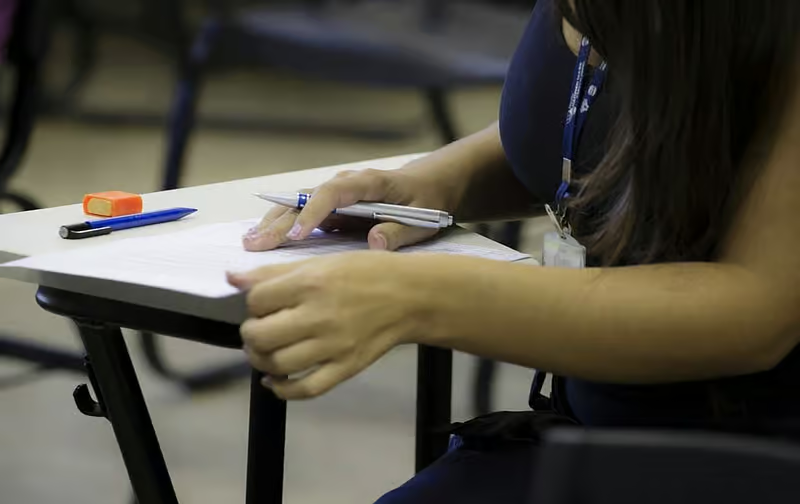
Instead of conventional written examinations, students were assessed through a Portfolio of Evidence. The system brought together coursework, internal assessments and academic work completed during the school year.
Educators say results reflected student performance
School leaders across Dubai have defended the assessment process, saying the final grades were broadly consistent with students’ demonstrated abilities and predicted results.
Fatima Martin, principal of GEMS New Millennium School in Al Khail, said many students received grades that closely matched their predicted results.
She also praised Cambridge International Education for introducing what she described as a structured assessment system in response to the extraordinary circumstances facing schools in the UAE and wider Middle East.
Andy Kai Fong, Secondary Principal at GEMS Wellington Academy Silicon Oasis, similarly said the portfolios provided accurate reflections of students’ performance.
He also highlighted the considerable emotional pressure faced by young people and their families during a highly disruptive academic year.
Some students and parents remain unhappy
Despite the positive response from educators, some parents have criticised the grades awarded through the PoE system.
One parent said her child received a surprisingly low grade in a subject where she had consistently achieved top marks during the year. The family planned to request a re-evaluation from the Cambridge board.
Some students also questioned whether the portfolio system gave them the same opportunity to demonstrate their abilities as traditional examinations.
One student who received grades of A*A and B, below a predicted AAA, said the process required significant effort within a compressed timeframe and that there was limited clarity around how the submitted evidence was assessed.
Another Dubai student compared the different examination boards and said Pearson Edexcel’s enhanced-grading approach felt fairer under the circumstances.
Teachers faced additional pressure
The unusual assessment system also transferred a significant amount of work to teachers and schools.
Sheridan Teasel, Head of Secondary at Dubai British School Emirates Hills, said students completed evidence under formal examination conditions designed to replicate A-Level papers. However, he noted that teachers had to take on substantial responsibilities that would normally have been handled by examination boards.
Rebecca Coulter of Dubai British School, Jumeirah Park, said students faced a more concentrated assessment schedule alongside coursework and other evidence.
At Safa Community School, more than 7,000 pieces of evidence were reportedly collected, quality-checked and submitted electronically to examination and awarding bodies.
The school also operated a 24-hour evidence drop-off facility to help students overcome logistical challenges.
Concerns extend to university admissions
For many students, receiving their results was not the end of the uncertainty.
While a large number met their university entry requirements, some students reportedly had to negotiate with universities after falling short of their conditional offers.
This has added another layer of anxiety for students who had prepared for conventional A-Level examinations before the unexpected shift to portfolio-based assessment.
Despite the disagreements over individual grades, educators say the students and teachers who navigated the unusual system showed remarkable resilience.
The 2026 UAE A-Level results therefore represent more than academic scores. They reflect an extraordinary year in which schools, teachers and students had to adapt quickly to circumstances far beyond their control.