
































The United States has announced a sweeping expansion of sanctions against Iran, targeting key sectors of the country’s economy as Washington seeks to intensify financial pressure on Tehran amid the continuing Middle East conflict.
The new measures announced by the US Treasury cover digital assets, technology, gold, aviation and shipping, while Washington has also warned countries and companies maintaining certain business ties with Iran that they could face consequences.
The latest escalation comes as tensions surrounding the Strait of Hormuz remain high and diplomatic efforts continue to prevent further disruption to regional trade and energy supplies.
US targets five critical sectors
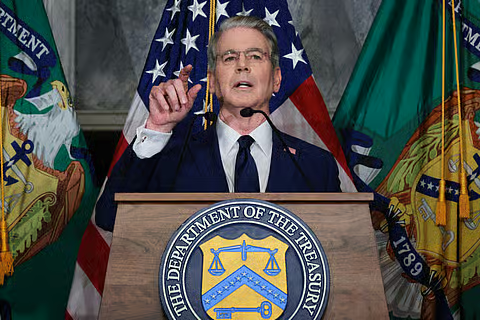
US Treasury Secretary Scott Bessent said Washington’s latest measures are designed to cut off financial channels supporting the Iranian economy.
According to the Treasury, the new sectoral sanctions focus on five areas that Iran relies on to generate revenue or sustain economic activity: digital assets, technology, gold, aviation and shipping.
The move represents a broader use of secondary sanctions, meaning businesses and entities outside Iran could also face restrictions if they continue activities identified by Washington as supporting Tehran.
Bessent said the United States intends to pursue entities involved in helping Iran circumvent sanctions and warned that companies facilitating money laundering connected to Iran could lose access to the US dollar financial system.
The warning significantly raises the stakes for international businesses that continue commercial relationships with Iranian entities.
Washington pressures Iran’s trading partners
The US campaign is not limited to Iranian companies.
Washington has also signalled that other countries could face pressure if they continue economic dealings with Tehran. Bessent said President Donald Trump had been contacting world leaders and urging them to reduce or end interactions with Iran.
The approach reflects a strategy aimed at making it increasingly difficult for Iran to maintain access to international financial networks.
For countries with commercial, energy or logistical interests in the region, the new sanctions could create difficult choices. Companies may have to weigh their business relationships with Iran against the possibility of losing access to the US financial system.
Iran warns of consequences
Tehran has rejected the US pressure campaign and warned countries against cooperating with Washington’s economic measures.
Iranian Foreign Ministry spokesman Esmaeil Baghaei said countries supporting the US campaign would face consequences and indicated that Tehran would use its bilateral relationships to resist the sanctions.
Iranian officials have also questioned Washington’s justification for expanding economic pressure, arguing that the new measures contradict US claims about having already weakened Iran’s military and strategic capabilities.
Iran’s Economy Minister Ali Madanizadeh said the government had prepared a two-year plan to manage the effects of the new sanctions.
The statement suggests Tehran expects the economic confrontation to continue rather than viewing the latest US measures as a short-term development.
Strait of Hormuz remains a major concern
The sanctions announcement comes against the backdrop of continued uncertainty around the Strait of Hormuz, one of the world’s most important maritime chokepoints.
Iran has warned vessels operating in the strait that ships violating its stated transit protocols could face measures including fines, detention or confiscation.
At the same time, shipping activity through the waterway has been significantly affected by the wider conflict and competing restrictions.
Recent tracking data indicated that fewer commodity vessels were crossing the strait over the weekend, highlighting the challenges facing international shipping companies.
The situation has raised concerns about energy supplies, freight costs and the wider economic consequences of prolonged disruption in the Gulf.
Oil markets remain sensitive to developments
The continuing uncertainty around Hormuz has kept global energy markets on alert.
Oil prices fell on August 24 as investors awaited details of the latest US sanctions package, although the broader geopolitical situation continues to create substantial uncertainty for crude markets.
The Middle East remains central to global energy supplies, making any prolonged disruption to shipping routes particularly significant for importers, producers and consumers.
Iran has warned that it could take further action against Gulf oil exports if what it describes as an economic war continues.
Such a development could potentially increase pressure on global energy markets, although the actual impact would depend on the scale and duration of any disruption.
Currency pressure deepens in Iran
The latest sanctions come as Iran’s economy is already under severe pressure.
The Iranian rial fell to a reported record low of more than 2 million rials per US dollar on the free market on August 24, according to tracking websites cited in reports.
Iran’s central bank governor Abdolnaser Hemmati described the currency weakness as temporary and said exchange-rate movements were fluctuating.
However, the continued depreciation has added to concerns over inflation, purchasing power and the ability of households and businesses to manage rising costs.
The currency pressure also demonstrates why access to international financial channels remains a central issue in the confrontation between Washington and Tehran.
Pakistan pushes for diplomacy
While economic pressure is increasing, diplomatic efforts have not stopped.
Pakistan’s army chief, Asim Munir, travelled to Tehran as Islamabad continued efforts to support dialogue between Iran and the United States.
Munir’s visit came after a reported conversation with President Trump. Sources said the US president had spoken with the Pakistani military chief ahead of his Tehran trip.
Pakistan has positioned itself as a potential intermediary as regional tensions continue, with the country’s leadership seeking to encourage negotiations and contribute to efforts aimed at restoring stability.
Oman is also expected to remain involved. Iran said Oman’s Foreign Minister Sayyid Badr Albusaidi would visit Tehran to continue discussions related to the Strait of Hormuz.
These diplomatic contacts underline the contrast between the economic escalation and parallel attempts to find a political route out of the crisis.
UN offers help with Hormuz transit
The United Nations has also proposed a mechanism aimed at facilitating the movement of fertilizer through the Strait of Hormuz.
UN Secretary-General Antonio Guterres said the organisation could serve as a neutral facilitator by registering and verifying ships carrying fertilizer and related products.
The proposal is intended to reduce immediate risks and support more predictable maritime transit while creating conditions that could help diplomatic efforts.
However, the UN stressed that such a mechanism would require agreement from the countries involved and would not change the legal rights or obligations of states under international law.
Wider regional risks remain
The Iran sanctions crisis is unfolding alongside broader security problems across the Middle East.
A Saudi shipping company confirmed that one of its vessels, the Amzan, was attacked in the Red Sea. The incident followed claims by Yemen’s Houthi movement regarding an attack on a vessel near Saudi Arabia.
Separately, reports of an Iran-linked cyber incident involving a small British energy facility prompted the UK government to brief energy companies about cybersecurity measures. British officials stressed that there had been no wider threat to the country’s electricity grid.
The developments illustrate how the conflict is extending beyond conventional military confrontation, affecting shipping, energy infrastructure, finance and cybersecurity.
Markets watch the next move
Investors are now focused on how Iran, its trading partners and international companies respond to the expanded sanctions.
The immediate question is whether the measures will significantly reduce Iran’s ability to access international markets or instead encourage Tehran to develop alternative trading and financial channels.
Iran’s leadership has indicated that it intends to withstand the pressure, while Washington is signalling that it wants to make sanctions increasingly difficult to bypass.
That creates a potentially prolonged economic standoff.
For businesses operating across the Middle East, the situation could mean greater compliance requirements, increased shipping risks and uncertainty over transactions involving Iranian counterparties.
What the latest sanctions mean
The latest US measures mark another significant stage in the economic confrontation between Washington and Tehran.
The focus on technology, digital assets, gold, aviation and shipping broadens the areas exposed to sanctions and increases pressure on international companies that have dealings with Iran.
At the same time, Iran’s warnings over the Strait of Hormuz and its threats to respond to economic pressure create additional uncertainty for global shipping and energy markets.
Diplomatic initiatives by Pakistan, Oman and the United Nations could provide avenues for de-escalation, but the immediate trajectory remains uncertain.
For now, the US is tightening economic restrictions while Iran says it is preparing for a prolonged confrontation. The outcome could have consequences well beyond the two countries, particularly for Gulf shipping, global energy markets and businesses with exposure to the region.
Dubai Herald will continue to track developments around the Iran sanctions, the Strait of Hormuz and the wider Middle East crisis as new measures and diplomatic efforts unfold.