

































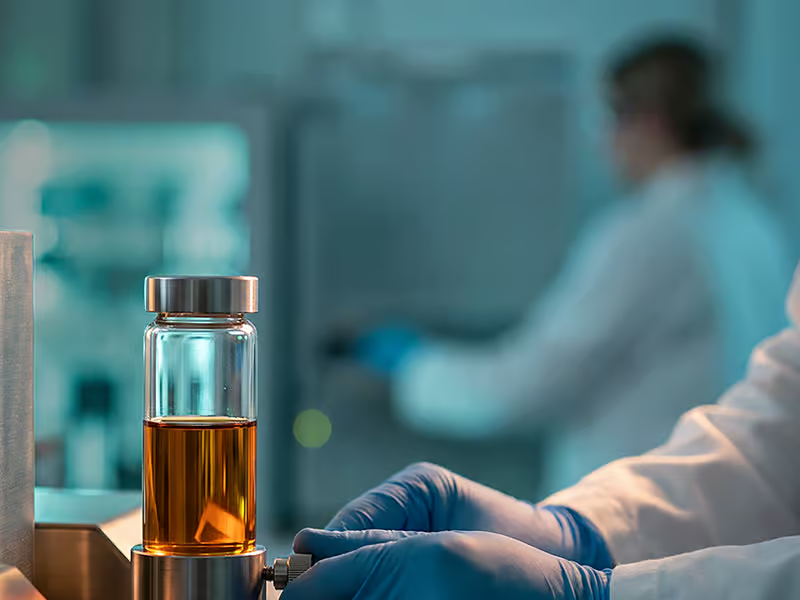
Dubai is taking another step toward faster and more efficient food-safety monitoring with the introduction of automated laboratory technology capable of analysing oils and fats in just two minutes.
The new system, deployed at the Dubai Central Laboratory, replaces a testing process that could previously take around two hours. It allows samples to be processed automatically, without continuous human intervention, while generating results designed to meet the accuracy and reliability required under international standards.
The development is expected to strengthen Dubai’s ability to monitor food products, particularly as the emirate continues to expand its laboratory and regulatory capabilities.
Testing capacity rises tenfold
One of the most significant advantages of the new technology is the increase in testing capacity.
The Dubai Central Laboratory can now process up to 60 samples a day, compared with around six previously. That represents a 900 per cent increase in daily capacity and gives authorities greater scope to handle larger volumes of food-related samples.
The faster turnaround also means potential quality problems can be identified much earlier.
Oils and fats can undergo oxidation during manufacturing and storage, potentially affecting their quality. By detecting early indicators of oxidation more quickly, laboratory specialists can support more proactive food-safety monitoring and regulatory action.
Automated analysis reduces manual work
Unlike conventional testing procedures that can require considerable manual involvement, the new system analyses samples automatically and produces results with minimal human intervention.
This automation can help laboratories manage growing workloads while maintaining consistent testing procedures.
For Dubai, the move is part of a wider push to use advanced technology to improve public services and regulatory operations. Faster laboratory analysis can give authorities a more efficient way to respond to potential food-quality concerns while supporting businesses operating within approved safety requirements.
Technology also supports greener laboratory operations
The new testing system is not only designed to improve speed.
It also reduces reliance on chemical consumables used in some conventional laboratory testing methods. This can lower resource consumption and reduce the environmental footprint associated with laboratory operations.
The combination of faster testing, greater capacity and reduced consumption reflects a broader shift toward more automated and sustainable laboratory practices.
Hind Mahmoud Ahmed, Director of the Dubai Central Laboratory Department at Dubai Municipality, said the technology would improve the speed and efficiency of testing while preserving the accuracy necessary for food safety and consumer protection.
She said the increased capacity would strengthen proactive regulatory processes and allow authorities to respond more efficiently to developments in the food manufacturing sector.
Strengthening consumer confidence
For consumers, the significance of the technology goes beyond laboratory efficiency.
Food-safety authorities rely on testing systems to verify that products meet established quality and safety requirements. Faster analysis can help shorten the time between sample collection and the identification of potential problems.
Dubai Municipality said the technology would contribute to strengthening confidence in the safety and quality of food products available in the emirate.
The development is particularly relevant to Dubai’s large and diverse food sector, which includes locally produced, imported and processed food products.
Dubai expands advanced food testing capabilities
The automated oil and fat testing system is part of a broader expansion of Dubai’s food-testing infrastructure.
Earlier in 2026, Dubai Municipality introduced the ViruGenetics Lab at Dubai Central Laboratory, described as the UAE’s first laboratory dedicated to detecting foodborne viruses.
The facility uses genomic technologies to analyse complex food samples, including dairy products, seafood, juices and fresh produce. It can process around 60 samples per day under normal conditions, with capacity rising to approximately 100 samples during emergencies.
Its testing procedures operate in accordance with ISO/IEC 17025 standards, providing a framework for laboratory competence and reliable testing.
Together, these developments point to a growing emphasis on technology-driven food safety in Dubai.
What the development means for Dubai
The latest laboratory upgrade illustrates how automation can change the way public authorities monitor food quality.
Reducing a test from two hours to two minutes can significantly improve turnaround times. Increasing daily capacity from six samples to 60 also gives regulators more flexibility when dealing with higher testing demands.
At the same time, reducing chemical consumption supports Dubai’s efforts to make government and laboratory operations more sustainable.
As food production, distribution and consumption become increasingly complex, faster testing systems could play an important role in helping authorities identify potential risks before they become wider public concerns.
For Dubai residents and visitors, the immediate impact may not always be visible. But behind the scenes, faster laboratory testing can provide an additional layer of oversight designed to protect food quality, strengthen regulatory enforcement and maintain consumer confidence.