































The conflict involving Iran, Israel and the United States has sharply disrupted maritime traffic around the Strait of Hormuz, with the International Maritime Organization (IMO) reporting 68 confirmed incidents in the Gulf and surrounding waters over the past six months.
At least 20 seafarers and port workers have been killed, while 35 others were injured and one person remains missing, according to figures cited by the UN maritime agency.
The incidents highlight the growing risks facing commercial shipping in one of the world’s most strategically important waterways.
68 maritime incidents recorded
The IMO said the 68 incidents amount to roughly one reported incident every 2.6 days during the six-month period.
Tankers accounted for about half of the incidents, while container ships represented around 20 per cent and bulk carriers approximately 15 per cent.
The United Kingdom Maritime Trade Operations (UKMTO) classified 47 of the reported incidents as attacks.
Vessels registered under the Liberian flag were involved in 13 incidents, making them the most affected among the reported nationalities. Panama-flagged and Marshall Islands-flagged vessels each featured in 10 incidents, while Iran-flagged ships were involved in four.
The frequency of incidents has varied throughout different stages of the conflict, reflecting changes in military activity and maritime security conditions.
Thousands of sailors remain stranded
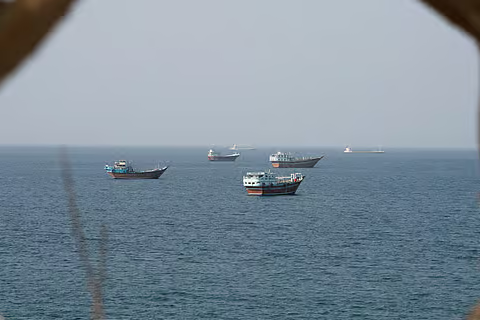
The disruption has also left thousands of maritime workers and vessels unable to move freely through the region.
The IMO said around 6,000 sailors and 500 ships remained stranded in the Gulf as of Tuesday.
The organisation has been involved in efforts to establish secure maritime routes and had launched an initiative in June aimed at evacuating more than 11,000 seafarers trapped in the Gulf.
That effort was later suspended following an attack on a vessel.
The IMO said discussions over establishing safer maritime access were continuing, but any progress would depend heavily on broader de-escalation in the region.
Tanker struck off Oman
The latest maritime incident reported on Tuesday involved an oil tanker that was struck by an unidentified projectile off the coast of Oman in the Strait of Hormuz.
According to the UKMTO, the vessel sustained damage to its engine room and was disabled. No casualties were reported and the crew was said to be safe.
The incident occurred around nine nautical miles northeast of Ash Shishah in Oman. Authorities did not immediately identify the ship’s nationality or disclose its direction of travel.
The latest strike adds to concerns over the safety of commercial shipping as efforts continue to restore normal traffic through the waterway.
Strait traffic remains far below normal
The Strait of Hormuz is critical to global energy markets. Before the current disruption, roughly one-fifth of global oil and liquefied natural gas exports passed through the waterway.
Traffic has fallen dramatically since Iran closed the strait on March 1 following joint US-Israeli strikes.
Data analysed by maritime tracking company Kpler showed that commodity carrier traffic fell to an average of around 10 transits a day, compared with approximately 95 daily transits in February.
A US-Iran agreement reached in June temporarily improved maritime traffic, with the number of daily transits rising to about 36.
However, traffic declined again after hostilities resumed on July 8. Between July 8 and August 22, the average dropped to around 15 transits per day.
Iran’s Revolutionary Guards have also warned of a maritime danger zone covering approximately 1,400 square kilometres, where mines may be present.
Pakistan and Iran discuss reopening Hormuz
Amid the continuing disruption, Pakistan has stepped up diplomatic efforts aimed at reducing tensions.
Pakistan’s army chief, Asim Munir, held discussions with Iranian leadership during a visit to Tehran. The talks focused on preventing further escalation, reopening the Strait of Hormuz and finding a negotiated path toward ending the conflict.
Pakistan’s Interior Minister Mohsin Naqvi, who accompanied Munir, said the discussions made “significant progress”.
The Pakistani side said both countries exchanged views on regional peace and possible measures to reach a negotiated settlement.
The diplomatic push comes as the economic and strategic consequences of the conflict continue to spread beyond the immediate region.
China warns over new Iran sanctions
The maritime crisis is also unfolding alongside increased economic pressure on Iran.
China said Tuesday that it would take measures to safeguard its interests after Washington announced plans for tougher sanctions targeting Iran and entities connected to Tehran.
Beijing criticised unilateral sanctions and warned that it would protect its rights and interests.
The developments could add another layer of uncertainty for international trade and energy markets, particularly if restrictions further affect Iranian oil exports or shipping routes.
What happens next?
The future of commercial shipping through the Strait of Hormuz remains closely tied to the wider security situation.
A sustained reduction in attacks and progress toward a political settlement could allow maritime traffic to recover. Continued hostilities, however, could keep vessels away from the waterway and increase pressure on global energy and shipping networks.
For thousands of seafarers still stranded in the Gulf, the immediate priority remains safe passage.
With 68 maritime incidents already recorded and at least 20 people killed, the figures underline the human cost of the disruption as efforts continue to restore security around one of the world’s most important shipping routes.