
























Gulf countries need to strengthen their own defence capabilities and improve coordination among GCC members while continuing to rely on the United States as a major security partner, experts said during a regional security discussion.
The debate reflects a changing security environment in the Gulf, where governments are seeking greater freedom to respond to threats independently while recognising the military capabilities and strategic reach that Washington continues to bring to the region.
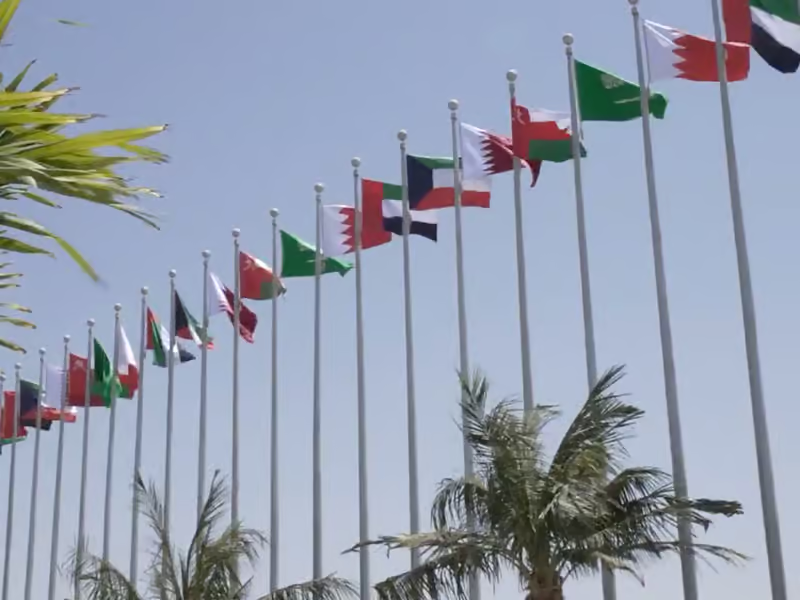
Experts speaking at the Hili Forum argued that Gulf security can no longer depend on a single layer of protection. Instead, they called for stronger national capabilities, closer GCC cooperation and a broader network of international partnerships.
Gulf states face an evolving threat landscape
Professor Abdulkhaleq Abdulla, a non-resident senior associate at the Emirates Center for Strategic Studies and Research, identified Iran as a major long-term security concern for the Gulf.
He said individual countries would struggle to address such challenges alone, making collective regional coordination increasingly important.
At the same time, Abdulla highlighted the importance of national deterrence, pointing to the UAE’s demonstrated ability to respond independently when faced with serious security threats.
His assessment underscored one of the central themes of the discussion: Gulf states want to become more self-reliant without abandoning the external security relationships that remain strategically important.
Affordable drones are changing defence calculations
The changing nature of warfare was another major focus of the discussion.
Firas Maksad, managing director of the Middle East and North Africa practice at Eurasia Group, pointed to the growing challenge posed by relatively inexpensive drones and other asymmetric weapons.
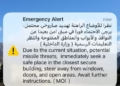
The imbalance between the cost of an attacking drone and the expensive systems sometimes required to intercept it is forcing governments to reconsider traditional approaches to air defence.
Maksad described this trend as the “democratisation of violence”, arguing that low-cost technologies can give smaller actors access to capabilities that were once largely limited to states with substantial military resources.
The development is particularly significant for Gulf countries, where critical infrastructure, energy facilities and major transport networks can present attractive targets.
Air defence becomes a regional priority
Dr. Zafer Al-Ajmi, executive director of the Gulf Monitoring Group in Kuwait, said recent developments had already influenced military thinking across the region.
Air defence, he noted, has moved to the forefront of Gulf security planning.
He outlined a five-level security structure involving national armed forces, GCC collective security mechanisms, international allies, Arab defence arrangements and friendly countries.
Countries such as Pakistan and Türkiye are increasingly relevant within this broader network, although experts noted that their capabilities do not completely replicate the United States’ ability to deploy military power over long distances and move assets rapidly into the Gulf.
GCC cooperation remains central
Greater coordination among Gulf countries emerged as another key priority.
A stronger collective framework could allow GCC states to share capabilities, coordinate responses and reduce vulnerabilities that individual countries may face when acting independently.
Such cooperation would not necessarily mean creating a single defence structure. Instead, it could involve greater interoperability, intelligence sharing, coordinated air defence and joint planning for emerging threats.
The approach would also give Gulf governments greater flexibility when deciding which partners and capabilities to activate during a crisis.
Moving from dependence to flexibility
Dr. Khalid Al-Jufairi, adjunct associate professor of international politics at Georgetown University in Qatar, proposed what he described as a “modular” approach to Gulf security.
Rather than depending heavily on one supplier or external power, the model would allow Gulf states to draw on different partners according to the circumstances.
The objective, he suggested, is not to eliminate outside dependence altogether. Instead, Gulf countries should have sufficient political and operational options to make independent choices during a crisis.
That could involve combining national military capabilities with GCC resources and assistance from different international partners.
Technology and local defence industries
Dr. Dania Thafer, executive director of the Gulf International Forum, stressed the importance of technology transfer and developing local capabilities.
For Gulf countries seeking greater strategic autonomy, access to advanced technology will be critical. Building domestic industries could also reduce vulnerabilities associated with relying entirely on foreign suppliers.
Thafer argued that long-term partnerships should therefore focus not only on purchasing defence equipment but also on gaining access to technology and developing local expertise.
She also stressed that modern security planning needs to protect more than physical borders and military facilities. Digital networks, communications systems and wider connectivity have become increasingly important parts of national security.
The US remains difficult to replace
Despite calls for greater autonomy, the discussion did not suggest that Gulf countries are ready to replace the United States as their principal external security partner.
The US retains significant advantages in areas such as long-range military deployment, advanced defence technology and the ability to rapidly project power into the region.
Experts instead pointed towards diversification as a way to complement the American role rather than immediately replace it.
Middle powers and regional partners could play a larger role in specific areas, while Washington continues to provide capabilities that remain difficult for other countries to match.
A more diversified Gulf security model
The emerging picture is one of a Gulf security system built around multiple layers rather than a single dominant partner.
National defence capabilities would form the foundation, while GCC coordination could provide collective strength. International allies and regional partners would add further capabilities, giving governments more choices during periods of heightened tension.
Such a model could also help Gulf states respond to newer forms of warfare, including drones, cyber threats and attacks against critical infrastructure.
The experts’ recommendations varied, but their broader message was consistent: Gulf countries need greater capacity to defend themselves while maintaining strong partnerships abroad.
For the region, the challenge will be finding the right balance between strategic independence and international cooperation as security threats continue to evolve.