
































The conflict between the United States and Iran has entered another dangerous phase, with fighting spreading across shipping routes, military positions and energy infrastructure in the Middle East.
US President Donald Trump said he believes the war could end “immediately” after the US midterm elections in November, arguing that Iran would not be able to sustain the conflict. His comments came as the two sides traded attacks involving oil tankers and military targets around the strategically important Strait of Hormuz.
The latest escalation has also raised concerns for Gulf shipping, global oil supplies and regional security, with several countries responding to attacks or issuing warnings.
Trump predicts war could end after US midterm elections
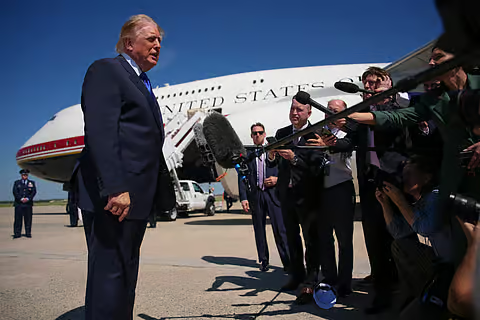
Speaking to reporters on Wednesday, Trump said he expected the conflict to come to an end after Americans vote in the November midterm elections.
He argued that Iran was struggling to continue the war and accused Tehran of attempting to influence the US political process.
The statement came as Iran and the US exchanged another series of attacks, highlighting the uncertainty surrounding any potential diplomatic resolution.
Iran’s Revolutionary Guards, meanwhile, said the conflict could end if Washington stopped what Tehran described as threats and met a series of demands.
Those conditions include issues involving Iran’s nuclear programme, Israeli military operations in Lebanon, the blockade of Yemen and Iranian frozen assets.
Tanker attacks deepen fears over Strait of Hormuz
One of the most significant developments has been the growing threat to commercial shipping.
Iran said it attacked 10 vessels near the Strait of Hormuz after US forces destroyed five Iranian oil tankers. The exchange represents one of the largest waves of attacks on shipping since the conflict began.
Iran also warned that tankers connected to US allies could become targets, adding further pressure on a waterway that plays a crucial role in global energy transportation.
The United Kingdom Maritime Trade Operations agency reported that several merchant vessels in the northern Gulf and Gulf of Oman had been hit by disabling fire during military activity.
The agency said it could not immediately confirm casualties or environmental damage.
Iran launches missile attack toward Jordan
Iran also launched missiles toward a US military facility in Jordan.
Jordanian authorities said they intercepted 18 of 20 missiles. The two missiles that reached the country fell in unpopulated areas, according to officials, and no casualties were reported.
The attack prompted strong reactions across the region.
The UAE condemned the strike, describing it as a violation of Jordan’s sovereignty and expressing solidarity with the kingdom.
Saudi Arabia and Qatar also condemned the Iranian attack and voiced support for Jordan’s security.
Oil prices return to the $100 mark
The renewed fighting has also unsettled global energy markets.
Brent crude rose above $100 a barrel on Wednesday for the first time since late July before easing slightly. The increase reflected growing concerns that continued attacks could disrupt oil production, exports and shipping routes.
The Strait of Hormuz remains particularly important because of its role in the movement of Middle Eastern energy supplies.
With military activity affecting both commercial vessels and tanker traffic, traders have continued to price in a higher risk premium.
Iran expands maritime warning zone
Iran’s Revolutionary Guards said maritime restricted areas would extend beyond the Strait of Hormuz toward parts of the Gulf of Oman and the Arabian Sea.
The precise coordinates were expected to be announced separately.
Iran said vessels entering the restricted area without coordinating with its authorities could face sanctions.
The announcement adds another layer of uncertainty for shipping companies operating through the region and comes amid already heightened insurance and security concerns.
Tanker struck in Iraqi waters
The shipping disruption extended into Iraqi territorial waters, where a tanker carrying about two million barrels of Iraqi fuel oil was reportedly hit by a drone.
The vessel, identified as the Panama-flagged New Andros, caught fire after the incident. Iraqi officials said the 22 crew members were safe and that there were no immediate reports of casualties.
Iraq’s oil ministry separately said another vessel used to store fuel oil had been struck by an unidentified source. Officials said there was no reported leakage from its cargo.
Fatal incident reported off Dubai
The conflict’s wider impact was also felt near the UAE.
A crew member aboard the Gibraltar-flagged oil products tanker Hercules Star died following an incident while the vessel was anchored off Dubai, according to its charterer.
One additional crew member was reported missing, while the remaining crew were accounted for. Details surrounding the cause of the incident were not immediately provided.
The development underscored the heightened risks facing commercial shipping in and around the Gulf.
IAEA resolution sends Iran issue back to UN Security Council
The diplomatic pressure on Tehran also increased after the International Atomic Energy Agency’s 35-member Board of Governors approved a resolution reporting Iran to the United Nations Security Council over alleged breaches of its non-proliferation obligations.
It was the first time in two decades that the nuclear watchdog’s board had taken such action against Iran.
Iran rejected the resolution, arguing that it had been adopted under political pressure from the United States and its allies.
The decision could further complicate efforts to resolve the conflict through diplomacy, particularly as military tensions continue to rise.
Saudi Arabia faces renewed Houthi attacks
Another front has opened in Yemen, where Iran-backed Houthi forces have intensified attacks against Saudi Arabia.
Houthi media reported more than 30 Saudi airstrikes across several Yemeni provinces, although Saudi authorities did not immediately comment on the claim.
The escalation followed Houthi attacks on Saudi territory that reportedly injured dozens of people.
The widening conflict has increased concerns that instability could spread across multiple countries and threaten critical energy infrastructure and transportation routes.
South Korea weighs role in Strait of Hormuz
The crisis is also drawing international powers deeper into the debate over security in the waterway.
In South Korea, protesters urged the government not to deploy troops to the Strait of Hormuz. The demonstrations followed discussions about a possible South Korean contribution to maritime security.
South Korean defence authorities have sent a fact-finding team to assess the situation, while officials stressed that no decision on deployment had been made.
Any involvement by additional countries could significantly alter the security calculations surrounding the strategic waterway.
Airlines begin restoring Dubai connections
Despite the regional security concerns, aviation links with Dubai are beginning to recover.
Germany’s Lufthansa Group said it would gradually resume flights to Dubai from late October, with its airlines expected to offer as many as 36 weekly flights at peak operations.
The move is expected to provide additional options for business and leisure travellers while signalling a cautious return of international connectivity.
What happens next?
The latest developments point to a conflict that is becoming increasingly complex, with military action, maritime security, oil markets and diplomacy now closely intertwined.
Trump’s prediction that the war could end after the November US elections contrasts with the continuing escalation on the ground and at sea.
For Gulf countries, shipping operators and energy markets, the immediate priority remains limiting the risk of further disruption.
Whether diplomatic efforts can catch up with the rapidly changing military situation will be a major question in the weeks ahead.