






























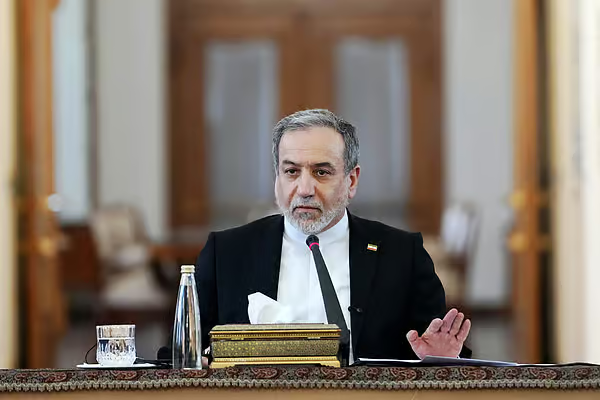
Iranian Foreign Minister Abbas Araghchi has dismissed US President Donald Trump’s declaration of an “Economic D-Day”, arguing that Washington’s pressure campaign is distracting attention from its own economic challenges.
Araghchi said the US approach was driven by domestic financial pressures, pointing to rising debt and interest costs in the United States. He also criticised what he called Washington’s continued reliance on policies that had failed to resolve the wider conflict.
The remarks come as the confrontation between the United States and Iran enters its sixth month, with diplomatic efforts showing little sign of progress.
Iran signals tougher military stance
Alongside the economic dispute, Iran has increasingly signalled a more aggressive military posture.
Iranian officials have indicated a shift from primarily retaliatory operations towards a stronger offensive approach. Analysts cited in international reports say the change could reflect Tehran’s belief that it can use military pressure and control of strategic waterways as leverage in negotiations.
Iran’s leadership has also called for stronger deterrence and preparations for larger-scale military operations.
Strait of Hormuz remains a major flashpoint
The Strait of Hormuz continues to be at the centre of the confrontation. The strategic waterway is vital to global energy shipments, and uncertainty over its status has affected commercial shipping.
Shipping data showed that nine commodity vessels passed through the strait on Wednesday, unchanged from the previous day, as uncertainty continued over the prospects for a settlement between Washington and Tehran.
The United States has maintained pressure on vessels operating in the region, while Iran continues to assert its position over the waterway.
UAE trade suspension draws US support
The latest developments also follow the UAE’s decision to suspend trade and financial transactions with Iran indefinitely amid escalating regional tensions.
US Representative Joe Wilson welcomed the UAE’s move, describing it as a significant step that could place additional economic pressure on Tehran.
The UAE decision came after its defence forces detected two ballistic missiles launched from Iran on August 18. The incident triggered an emergency alert for residents, while authorities later said the missiles had been assessed as targeting maritime navigation.
With diplomacy stalled, economic pressure increasing and tensions around the Strait of Hormuz continuing, the regional crisis remains highly uncertain.
Dubai Herald will continue to follow developments in the US-Iran conflict, Gulf security, shipping and the economic impact on the UAE and wider region.