














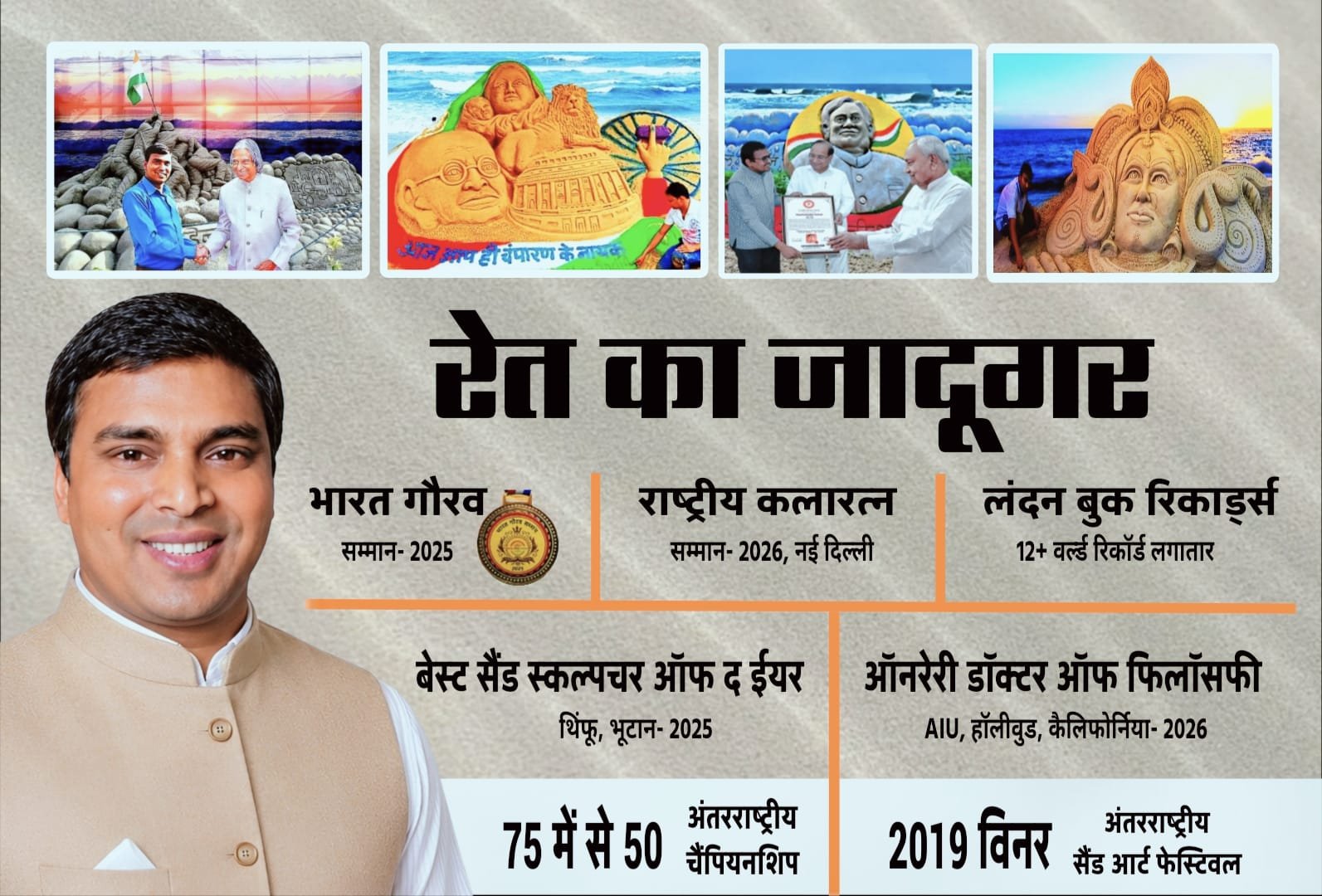
Bihar: From making figures out of mud and sand as a child to representing India on international platforms, Madhurendra Kumar’s journey is one of struggle, persistence and artistic determination. Known as a Sand Artist, Indian Sand Artist, International Sand Artist and Leaf Artist, Kumar has built a distinctive identity by transforming sand, leaves, fruits, vegetables, metals and even waste materials into works of art.
His story, however, is not simply about artistic achievement. It is also a story of poverty, hard work and a childhood in which earning a livelihood and pursuing education went hand in hand.
Born on September 5, 1994, in Barwakala in Bihar’s East Champaran district, with his ancestral village in Bijbani, Kumar grew up in an extremely poor Kanu Halwai family. His father, Shiv Kumar Sah, was a simple farmer who supported the family through agriculture.
Madhurendra was the eldest among five siblings. Financial difficulties shaped much of his childhood, but they also forced him to develop a strong sense of responsibility at an early age.
A Childhood Shaped by Poverty and Art
Madhurendra’s connection with art reportedly began when he was barely three years old.
His grandfather, the late Ramchandra Sah, would sit with him at home to teach him. But instead of remaining focused on conventional lessons, the young Madhurendra was more interested in creating shapes and figures.
He would draw swans and groups of ducks on his slate or make figures from mud on the ground.
His grandfather noticed the unusual ability and is remembered for predicting that the child would one day become a great artist.
That early observation would eventually prove significant.
At around five years of age, Madhurendra began helping his family by grazing buffaloes and goats. When he went near the river, however, the riverbank became more than a place for grazing animals. He began using the natural sand along the Aruna River to make houses, figures and sculptures.
Without formally knowing that he was developing a particular art form, he was gradually discovering the medium that would later become central to his identity as a Sand Artist.
Education Amid Financial Hardship
Madhurendra’s early education took place at the Government Middle School in his ancestral village of Bijbani, East Champaran.
His schooling was far from easy. Financial constraints meant that continuing his education required considerable personal effort.
He later pursued higher education at Mahatma Gandhi Kashi Vidyapith (MGKV), Varanasi, Uttar Pradesh, where he studied fine arts with a specialization in sculpture. He obtained a Bachelor of Fine Arts (BFA) in Sculpture and subsequently a Master of Fine Arts (MFA).
For Madhurendra, higher education was not simply an academic pursuit. It was achieved alongside a long period of financial struggle and work.
Selling Curd to Pay for Education
As a young student, Madhurendra took on a variety of jobs to support his education and family.
From around the age of seven, he reportedly went from house to house selling curd to help meet his educational expenses. He also made bamboo baskets and other bamboo products, sold green vegetables in local markets and worked in hotels.
During local festivals and fairs, he sold traditional snacks such as jhal-muri.
As he grew older, his skills expanded beyond traditional labour. He painted houses and shops, prepared signboards, worked in lettering and undertook drawing and painting assignments.
At different points, he also worked as a night guard and at a tailoring centre, where he performed tasks such as sewing buttonholes and attaching buttons to clothes.
He is also reported to have worked for private limited companies on surveys conducted under programmes directed by the Government of India and state governments, travelling from house to house for extended periods.
The jobs were varied, but the purpose remained the same: earning enough to continue his education and remain connected to art.
Six Months Sleeping in a College Corridor
The financial challenges continued even after Madhurendra entered college.
Unable to pay hostel fees, he reportedly spent around six months sleeping in the college corridor.
For many students, college represents a period of independence and opportunity. For Madhurendra, it was also a period of survival. Yet despite the lack of accommodation and financial security, he continued his education in fine arts.
The experience became another chapter in a journey in which education and artistic ambition had to coexist with economic hardship.
When Sand Became His Canvas
Madhurendra did not have the money to regularly purchase paints, brushes and other conventional art supplies.
The lack of resources pushed him toward materials that were freely available around him.
The sand along the Aruna River, a tributary associated with the Bagmati river system, became one of his earliest and most important artistic mediums.
What began with small figures made while grazing animals gradually developed into more elaborate sand sculptures.
This unconventional beginning became the foundation of his career as a sand artist.
Today, Kumar is associated with a wide range of artistic mediums, including sand, soil, coal ash, cement, fibre, POP, wax, copper, brass, aluminium, marble, granite, plywood, thermocol, grains, green leaves, fruits, vegetables and recycled or waste materials.
The Rise of Sand Art in North India
The history of sand art in North India, particularly in the context of Bihar, is associated with the late years of the 1990s and the beginning of the 2000s.
One of the early episodes associated with Madhurendra’s sand-art journey dates back to the devastating floods in East Champaran in 1998.
During the floods, he is said to have created a figure of Lord Indra from sand on the banks of the Aruna River while praying for the rains to stop.
For a young artist from a rural and economically disadvantaged background, the riverbank served as both a creative laboratory and a source of artistic material.
At a time when sand art was more commonly associated with India’s coastal regions, his work demonstrated how the art form could also develop in the riverine landscape of North India.
His early experiments eventually developed into large-scale sculptures and installations, helping establish his distinctive artistic identity.
A Turning Point: Recognition From Dr. A.P.J. Abdul Kalam
A significant turning point in Madhurendra Kumar’s journey came when his work attracted the attention of the country’s former President and renowned scientist, Dr. A.P.J. Abdul Kalam.
In 2005, Madhurendra created a reported 45-foot-high sand sculpture titled “Sarvadharm Shahadat”, which received appreciation.
His association with Dr. Kalam became particularly important in 2012, when Kalam appreciated Madhurendra’s canvas painting titled “The Importance of Science in Building a Developed India.”
The encouragement from Dr. Kalam had a deeper significance for the artist than a conventional award or recognition.
At a time when Madhurendra faced opposition and discouragement from sections of society, relatives and even people around him, the appreciation from a respected national figure gave him confidence to continue pursuing art.
Madhurendra has spoken in interviews about the importance of Dr. Kalam’s encouragement in helping him overcome a difficult period and continue moving toward national and international platforms.
Thousands of Artworks Across Multiple Mediums
Over the course of his artistic career, Madhurendra is reported to have created thousands of artworks across multiple categories.
His reported body of work includes more than 5,000 sculptures made from sand and ash, over 4,000 solid sculptures using materials such as marble and metals, and more than 21,000 leaf-art carvings.
He has also created over 3,000 fruit and vegetable artworks, around 2,000 plywood and thermocol artworks, more than 500 grain-art creations and over 1,000 artworks made from waste and recycled materials.
This wide range of work has contributed to his identity not only as a Sand Artist, but also as a Leaf Artist and multidisciplinary Indian artist.
Representing India Across the World
Madhurendra Kumar’s work eventually moved beyond Bihar and India.
According to his profile, he has represented India more than 75 times across 25+ countries and has received more than 100 national and 50 international awards.
He is also credited with more than 12 world records associated with his artistic work.
His international appearances have provided him with opportunities to showcase Indian art and culture to audiences outside the country.
For an artist who began by working with naturally available sand because conventional materials were unaffordable, the transition to international platforms represents a remarkable change in scale.
Art With a Social Message
Madhurendra’s work is not limited to decorative sculptures.
He frequently uses art to communicate messages related to environmental protection, world peace, water conservation, cleanliness, de-addiction, natural disasters, terrorism and other issues of public interest.
His large-scale sand sculptures and installations allow complex social messages to be communicated visually, often without relying heavily on written language.
This combination of art and social awareness has become one of the defining elements of his work.
Madhurendra Art & Craft Research Institute
Madhurendra Kumar’s contribution to art extends beyond his own creations.
The Madhurendra Art & Craft Research Institute was established in Bihar in 2004 by sand artist Madhurendra Kumar.
The institute aims to provide free art education and training to talented children from rural and economically weaker backgrounds. It works across areas including sand art, leaf art, fruit art, painting, sculpture and folk arts.
The institute also seeks to contribute to the preservation and development of artistic traditions while encouraging self-employment, self-reliance, social awareness and the global promotion of Indian culture through art.
For an artist who himself grew up with limited access to resources, creating opportunities for children from disadvantaged backgrounds adds another dimension to his artistic journey.
Madhurendra Kumar’s Art Journey in Current Affairs
The achievements and artistic journey of Bihar’s Sand Artist Madhurendra Kumar have also begun to find a place in discussions around Current Affairs, particularly among aspirants preparing for competitive examinations.
His art journey, national and international honours, reported world records and contribution to Indian art are being discussed as part of general knowledge and current-affairs preparation.
For candidates preparing for IAS, UPSC, BPSC and JPSC 2026, educational discussions and question-and-answer sessions associated with platforms such as Drishti IAS and Khan Global Institute have highlighted facts related to Madhurendra Kumar’s artistic achievements and international recognition.
His story therefore extends beyond the art world. For students, it brings together subjects such as Indian art and culture, Bihar’s cultural identity, social awareness, international representation, awards and contemporary achievements.
Recognition in 2026
Madhurendra’s international profile received further recognition in 2026.
According to his profile, America International University (AIU), Hollywood, California, conferred upon him an Honorary Doctor of Philosophy in Sand Art in recognition of his contribution to the field and his work on an international scale.
His profile also cites honours from prominent personalities and institutions, including former Bihar Chief Minister Nitish Kumar, Prime Minister Narendra Modi and former President of India Dr. A.P.J. Abdul Kalam, along with other national and international personalities and organizations.
From a Riverbank to the Global Art Stage
Madhurendra Kumar’s story is ultimately about much more than sand.
It is about a child from an extremely poor Kanu Halwai family who began making figures from mud, a young boy who grazed buffaloes and goats along the river, a student who sold curd and vegetables to pay for his education, an artist who spent months sleeping in a college corridor because he could not afford hostel fees, and a young creator who used river sand because he could not afford paints and brushes.
Those circumstances could have ended his artistic ambitions.
Instead, they became part of the foundation of his career.
His journey from the Aruna River in East Champaran to national and international platforms has established him as an Indian Sand Artist, International Sand Artist, Leaf Artist and Indian Artist.
His work continues to combine creativity with social messages, while his institution seeks to give other young and economically disadvantaged artists access to training and opportunity.
Today, Madhurendra Kumar’s canvas extends from sand and leaves to marble, metal, fruit, vegetables, grains and recycled materials. But the central idea behind his work remains remarkably simple: when resources are limited, creativity can find its own medium.
Read More : UAE Authorities Take Action Against Two Individuals Over Offensive Social Media Live Broadcast