


































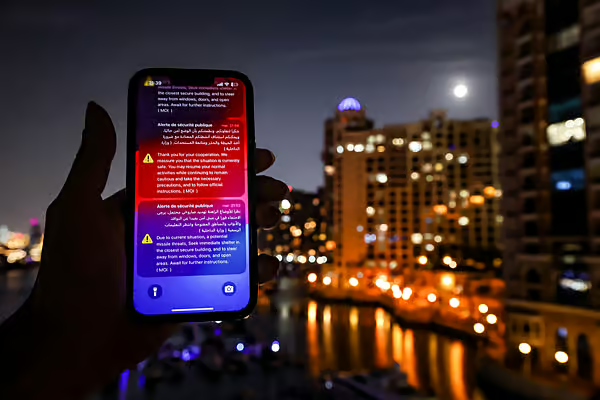
The UAE’s emergency alert system is designed to deliver critical warnings to residents within seconds, turning a complex national response network into a message and alarm on a mobile phone.
Residents experienced the system again on Tuesday when an emergency warning advised people to move to a secure building, stay away from windows, doors and open areas, and await further instructions amid a reported missile threat. The alert was lifted about 10 minutes later after authorities confirmed that the situation was safe.
The warning was the first of its kind since July 12, highlighting how the UAE’s national early-warning infrastructure works during potential security emergencies.
How UAE emergency alerts work
The alert that appears on a mobile phone is not an ordinary SMS. It uses Cell Broadcast technology, which allows authorities to send warnings simultaneously to compatible phones connected to selected mobile-network cells.
Unlike traditional text messages, Cell Broadcast does not require authorities to identify individual phone numbers. Instead, warnings can be directed to a specific geographic area, a number of mobile cells or, when necessary, the wider network.
The UAE’s Telecommunications and Digital Government Regulatory Authority (TDRA) has established technical requirements for the UAE-Alert system, allowing emergency messages to reach compatible devices across different generations of mobile technology, including 4G and 5G networks.
Why the emergency alarm sounds differently
The distinctive emergency tone is part of the UAE’s technical warning standards rather than a feature created by individual smartphone manufacturers.
Emergency alerts are enabled by default and cannot be switched off by users. When activated, a compatible phone displays the warning, vibrates and produces an emergency attention signal lasting about 10.5 seconds, even if the device is set to silent mode.
The system also supports different types of alerts, including warnings, tests and exercises, allowing authorities to distinguish an immediate emergency from routine public-safety communications.
What happens before residents receive an alert?
The mobile notification represents only the final stage of a much larger process.
The UAE operates national monitoring, early-warning and emergency coordination capabilities designed to assess potential threats and support decision-making. Relevant authorities continuously monitor developments and can issue precautionary warnings when necessary.
Importantly, receiving an emergency alert does not necessarily mean a threat is certain to hit the location of every person receiving it. The system is intended to give residents instructions while authorities continue assessing the situation.
The precise operational process linking threat detection, assessment, government authorisation and telecommunications distribution is not publicly detailed. However, the available information points to several distinct stages: monitoring and detection, threat assessment, emergency coordination, authorisation of a public warning and geographic distribution through mobile networks.
The phone is the final link
For residents, an emergency response may appear to begin when a phone suddenly vibrates and sounds an unfamiliar alarm. In reality, that notification is the final link in a sophisticated warning chain.
By the time the 10.5-second alarm reaches a mobile device, information has already moved through national monitoring, assessment and emergency communication systems before being distributed through the telecommunications network.
The UAE-Alert system is therefore designed not simply to inform residents, but to provide timely instructions that can help people respond quickly while authorities manage a developing situation.
Dubai Herald will continue to bring readers updates and explainers on UAE emergency systems, public safety and regional developments.
SEO Title:
Slug: how-uae-emergency-alerts-reach-your-phone
Meta Description:
SEO Tags: