



























The UAE has raised serious concerns over attacks on commercial vessels and the continued closure of the Strait of Hormuz, calling for the vital waterway to be reopened immediately and unconditionally.
Speaking at the 2026 BRICS Trade Ministers Meeting in Jaipur, India, UAE Minister of Foreign Trade Dr Thani bin Ahmed Al Zeyoudi stressed the importance of protecting freedom of navigation and ensuring the safe movement of international commercial shipping.
The remarks come as regional tensions continue to disrupt shipping and energy markets across the Gulf.
Adnoc reports attacks on 15 vessels
UAE energy company Adnoc said its operations have been significantly affected by attacks on its assets and employees since the regional conflict began.
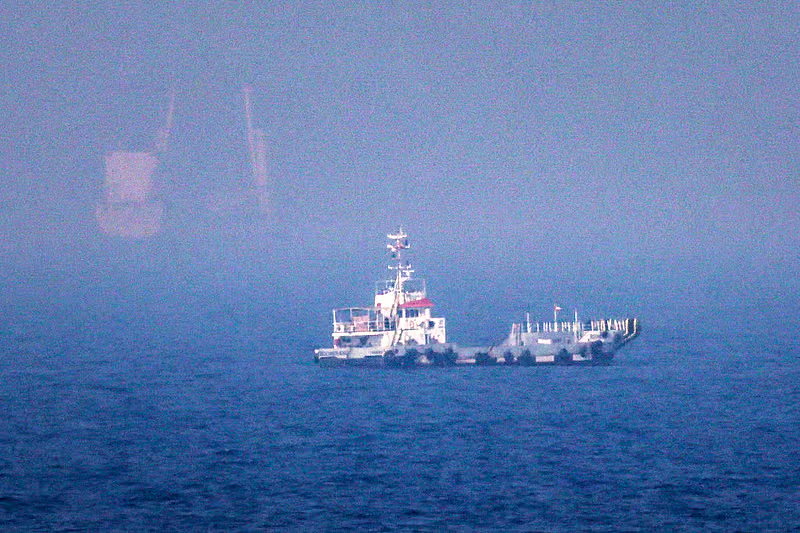
According to the company, 15 vessels have been targeted by missiles and drones while transiting the Strait of Hormuz. Three of those incidents reportedly occurred during the week leading up to the statement.
Adnoc said the attacks have resulted in one crew member being killed and 20 others injured.
The company called for freedom of navigation and uninterrupted commercial shipping through international waterways to be respected and protected under international law.
UAE urges protection of global shipping
Al Zeyoudi said the UAE remains deeply concerned about the impact of attacks on commercial shipping and the closure of the strategic waterway.
He reiterated the country’s position that the Strait of Hormuz should be reopened without conditions, while stressing the need to protect international maritime traffic.
The waterway is a critical trade route for energy and other goods, making continued disruption a concern for both regional economies and global commerce.
UAE-BRICS trade exceeds $312 billion
Despite growing geopolitical uncertainty, trade between the UAE and BRICS economies continued to expand in 2025.
The UAE’s non-oil trade with BRICS countries exceeded $312 billion last year, representing a 28.5 per cent increase from $243 billion in 2024.
BRICS nations accounted for about 31 per cent of the UAE’s total non-oil foreign trade in 2025. They also represented 34 per cent of the country’s imports, 23 per cent of non-oil exports and 28 per cent of re-exports.
During the Jaipur meeting, Al Zeyoudi also discussed expanding cooperation with India’s Commerce and Industry Minister Piyush Goyal in areas including services, digital commerce, logistics and food security.
UAE-India trade continues to grow
India remains one of the UAE’s key trading partners. Bilateral non-oil trade reached $76.2 billion in 2025, an increase of 17.3 per cent compared with the previous year.
The UAE’s participation in BRICS forms part of its wider strategy to expand international trade and strengthen economic links with emerging markets.
The country’s Comprehensive Economic Partnership Agreement programme aims to raise non-oil foreign trade to $1.1 trillion by 2031. Since the programme was launched in 2021, the UAE has concluded 38 agreements with economies across Asia, Africa, Europe and the Americas, with 18 currently in force.
As shipping disruptions continue, the UAE’s call for secure and uninterrupted passage through the Strait of Hormuz highlights the wider economic importance of keeping major international trade routes open.