











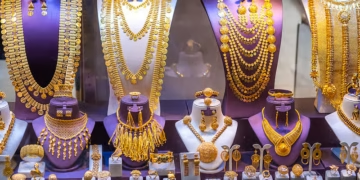





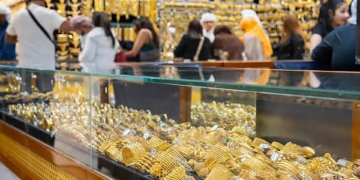

















Gold bought in Dubai is priced in UAE dirhams, but for the large number of Indian residents, NRIs and tourists who shop there, the number that matters is what it costs in rupees. That conversion depends on two moving parts — the dirham-denominated gold rate itself, and the AED-to-INR exchange rate at the time of purchase — both of which shift throughout the trading day. This guide explains how the Dubai gold rate is set, how it translates into rupees, why it tends to differ from prices back home, and what a buyer should verify before paying for a piece of jewellery or a bar of bullion.
What Is the Dubai Gold Rate in Indian Rupees?
The “Dubai gold rate in Indian rupees” refers to the price of gold, originally quoted in AED per gram or per tola in the UAE, converted into INR using the prevailing dirham-rupee exchange rate. It is not a rate set independently by any Indian authority; it is simply a currency conversion of the local Dubai price. Because both the gold price and the exchange rate change constantly during market hours, the INR figure a shopper sees on a comparison website is only ever a snapshot, not a fixed number they can rely on hours later.
Two separate markets are at play. Gold itself is priced globally in US dollars per troy ounce, based on the international benchmark set through the LBMA Gold Price auction. The UAE dirham has been pegged to the US dollar at a fixed rate of 3.6725 since 1997, so Dubai’s gold price in AED moves in close step with the global dollar price. The rupee, however, floats freely against both the dollar and the dirham, which means the INR figure can move even on a day when the AED gold price itself is flat.
Latest Market Information
Gold prices change throughout the trading day, and retail rates can also vary between jewellers depending on their sourcing costs and margins. Readers should check authorised UAE jewellers, bullion dealers, the Dubai Gold & Jewellery Group, or official market sources for the latest 22K and 24K rates before making a purchase, rather than relying on a figure quoted in an article or a third-party comparison site. The same applies to the AED-to-INR exchange rate, which a bank, forex dealer or licensed money changer can confirm at the point of transaction.
Dubai Gold Rate in Indian Rupees: How the Conversion Works
Converting the Dubai gold rate into rupees involves a simple two-step calculation, though the inputs themselves are what make it tricky to pin down in advance.
First, the retail price per gram in AED is taken from a jeweller or a verified rate source, broken down by purity — 24K, 22K, 21K or 18K. Second, that AED figure is multiplied by the current AED-to-INR exchange rate, which fluctuates through the day based on interbank currency markets, RBI reference rates, and the retail margins that individual banks or money changers apply.
This is why the rupee price of the “same” gold rate can differ depending on where a person checks it. A bank forex counter, an airport currency exchange kiosk and an online converter tool can each show a slightly different AED-to-INR rate at the same moment, because each applies its own spread. Travellers converting cash or paying by card should also account for the markup their card network or bank applies, which is usually separate from the interbank rate quoted online.
For an accurate, real-time figure, it is best to check a live gold price tracker for the AED rate and a licensed forex platform or bank for the current exchange rate, rather than using a fixed number from any single source.
Why Gold Costs Differ Between Dubai and India
Buyers frequently notice that gold priced in Dubai works out cheaper per gram than the same purity in India, even after conversion to rupees. Several structural factors explain the gap, rather than any single one.
Taxes and duties. The UAE applies 5% VAT on gold jewellery, and gold bars and coins meeting minimum purity standards are typically zero-rated for VAT as investment-grade metal. India, by contrast, applies both GST on gold jewellery and customs duty on gold imports, both of which add to the landed cost before it ever reaches a showroom.
Making charges. Making charges — the labour cost of turning raw gold into finished jewellery — tend to be lower and more negotiable in Dubai’s competitive souk environment than in many Indian retail chains, where fixed making-charge percentages are common.
Market structure. The Dubai Gold Souk operates as a dense cluster of independent jewellers competing directly on price and making charges, within a regulatory framework overseen by bodies such as the Dubai Gold & Jewellery Group. This concentrated competition tends to compress margins in a way that’s harder to replicate across India’s more geographically spread-out retail market.
Hallmarking and purity standards. Both markets enforce purity standards — India through BIS hallmarking, the UAE through its own assay and hallmarking requirements — but the verification systems differ, and buyers should understand which applies to a specific purchase.
Currency and global pricing. Since the AED is dollar-pegged, Dubai’s gold price reflects global spot movements almost immediately. Any given day’s INR comparison will also reflect how the rupee itself is trading against the dollar, independent of what’s happening in the gold market.
Factors That Influence Gold Prices Generally
Gold’s underlying price, in any currency, is driven by global forces rather than local ones. Understanding them helps explain why rates shift day to day.
International spot gold prices move with the US dollar’s strength — gold and the dollar typically have an inverse relationship. Central bank buying, particularly large-scale gold purchases by reserve managers, has been a significant driver of demand in recent years. US Federal Reserve interest rate policy affects gold’s appeal relative to yield-bearing assets: when rates or rate expectations fall, gold often becomes more attractive. Inflation expectations, geopolitical tensions, and broader global economic uncertainty tend to push investors toward gold as a perceived store of value. On the demand side, seasonal jewellery buying — around weddings, festivals like Diwali and Akshaya Tritiya in India, or Eid in the Gulf — adds periodic demand spikes that can influence retail premiums even when the underlying spot price is stable.
Is Buying Gold in Dubai Worth It?
There are genuine advantages that draw shoppers to Dubai. Making charges are often more competitive, the range of designs and purities available is extensive, and the absence of import duty on investment-grade bullion makes bars and coins comparatively attractive for those looking to hold gold as an asset. Zero-rated VAT on qualifying bullion is a further point in Dubai’s favour for investment buyers specifically.
There are also real trade-offs. Travellers carrying gold back to India must account for customs duty and declared value limits, which can offset some of the savings made in Dubai. Currency conversion costs, card markup fees, and the practical difficulty of verifying a jeweller’s certification while on a short trip all add friction. For jewellery bought as ornamentation rather than investment, design preference and after-sales service — such as resizing or exchange policies — may matter as much as the price per gram.
Whether Dubai works out cheaper in a specific case depends on the purity, the making charges quoted, the exchange rate on the day, and the applicable customs allowance — it is not a guaranteed saving in every scenario, and this article does not recommend buying or not buying based on price alone.
Customs Rules for Bringing Gold From Dubai to India
India permits eligible passengers to bring in a limited value or quantity of gold jewellery duty-free, with different allowances for men and women and additional duty payable above those thresholds; gold bars and coins are treated differently from jewellery under customs rules. These allowances, duty rates, and documentation requirements are revised periodically. Travellers should verify the latest customs regulations from the Central Board of Indirect Taxes and Customs or their airline/airport customs desk before travelling, rather than relying on previous trips or informal advice, since incorrect declarations can result in penalties or seizure.
Where to Buy Gold in Dubai
The Dubai Gold Souk in Deira remains the most well-known destination, housing hundreds of independent jewellers within walking distance of each other, which naturally encourages price comparison. Certified jewellery retailers — larger chains with standardised pricing and documented hallmarking — offer more predictability for buyers who prefer not to negotiate. Bullion dealers, often separate from jewellery retailers, cater to buyers purchasing bars and coins for investment rather than adornment. Shopping malls across Dubai also host branded jewellery outlets, typically at fixed prices with less room for negotiation than the souk but often with stronger after-sales service.
Before buying from any of these, a buyer should confirm the seller’s hallmarking certification, ask for a breakdown of metal cost versus making charges, and request a proper tax invoice.
Practical Buying Checklist
- Purity: Confirm whether the piece is 24K, 22K, 21K or 18K, and that this matches what’s marked and invoiced.
- Hallmark: Check for an official assay or hallmark stamp confirming purity.
- Weight: Have the piece weighed in front of you on a calibrated scale.
- Invoice: Insist on an itemised invoice showing gold weight, purity, per-gram rate, and making charges separately.
- Making charges: Ask whether these are a flat fee or a percentage, and whether they’re negotiable.
- Return policy: Understand the jeweller’s return window and conditions before paying.
- Buy-back policy: Ask what rate the seller will offer if you resell or exchange the piece later, and whether making charges are refunded.
- Certification: For diamond or gemstone-studded pieces, check for separate certification of the stones.
Common Mistakes Buyers Make
A frequent error is focusing only on the per-gram gold rate while ignoring making charges, which can vary significantly between sellers for otherwise identical pieces. Some buyers compare the AED price they see on a screen without checking the actual exchange rate applied by their card or cash exchange, which can differ meaningfully from the mid-market rate quoted online. Others buy without an itemised invoice, which can complicate resale, insurance claims, or customs declarations later. Underestimating or misunderstanding India’s customs-free allowance is another common issue, leading to unexpected duty payments at the airport. Finally, purchasing from uncertified or unfamiliar sellers — particularly under time pressure while travelling — increases the risk of paying for a purity level that isn’t accurately represented.
Frequently Asked Questions
Is Dubai gold cheaper than gold in India? It is often cheaper on a per-gram basis due to lower making charges and the absence of import duty on investment-grade bullion, but the actual saving depends on the day’s exchange rate, the specific jeweller’s making charges, and any customs duty payable when bringing gold back into India above the duty-free allowance.
How is the Dubai gold rate converted into rupees? The AED price per gram for a given purity is multiplied by the current AED-to-INR exchange rate. Both figures change throughout the trading day, so the rupee equivalent should be checked close to the time of purchase rather than in advance.
Why does the gold price in Dubai change several times a day? Dubai’s gold price tracks the international spot price, which is set through continuous global trading and the LBMA Gold Price benchmark. Because the dirham is pegged to the US dollar, any movement in the global dollar gold price feeds through to Dubai’s AED rate almost immediately.
What is the difference between 22K and 24K gold? 24K gold is 99.9% pure and too soft for most jewellery, making it more common for bars and coins. 22K gold contains around 91.6% pure gold alloyed with other metals for durability, and is the standard purity for most gold jewellery sold in the UAE and India.
Do I have to pay VAT on gold bought in Dubai? UAE VAT of 5% generally applies to gold jewellery. Investment-grade gold bars and coins meeting specific purity and form criteria are typically zero-rated for VAT, though buyers should confirm this with the seller for a specific product.
How much gold can I bring from Dubai to India without paying customs duty? India allows a limited value of gold jewellery to be brought in duty-free, with separate allowances for men and women, and gold bars or coins are treated differently under customs rules. These thresholds are subject to change, so travellers should verify current limits with Indian customs authorities before their trip.
Is it safe to buy gold from the Dubai Gold Souk? The Souk operates within a regulated framework, and most shops are established, licensed businesses. As with any market, buyers should still verify hallmarking, ask for a proper invoice, and avoid purchases made under time pressure or from unfamiliar sellers offering prices that seem unusually low.
Does the AED-to-INR exchange rate affect how much I pay, even if the gold price in AED stays the same? Yes. Since the rupee floats against both the dollar and the dirham, the INR cost of a fixed AED gold price can rise or fall purely due to currency movements, independent of any change in the underlying gold market.
Should I buy gold jewellery or gold bars in Dubai? This depends on intent. Bars and coins are generally more straightforward for investment purposes and often carry no VAT if investment-grade, while jewellery serves both an ornamental and, to some, a store-of-value purpose but carries making charges that aren’t recovered on resale. This is a personal decision based on individual goals, not investment advice.
Can I negotiate the price at the Dubai Gold Souk? Making charges are often negotiable at independent souk shops, particularly for larger purchases, though the underlying metal rate itself is generally standardised based on the day’s gold price. Branded retailers and mall outlets typically have less room for negotiation.
What documents should I keep after buying gold in Dubai? Keep the itemised tax invoice showing purity, weight and making charges, any certification for gemstones, and proof of purchase for customs declaration purposes when travelling back to India.
Why do different websites show different Dubai gold rates for the same day? Rates can differ because sources update at different intervals, some quote wholesale or spot-equivalent prices while others quote retail prices inclusive of margins, and small timing differences can matter in a market that moves throughout the day. For a purchase decision, the rate quoted directly by the seller at the time of sale is what matters.
Read More:
Conclusion
The Dubai gold rate in Indian rupees isn’t a single fixed number — it’s the product of two independently moving figures, the AED gold price and the AED-to-INR exchange rate, both of which shift throughout the trading day. Dubai’s combination of competitive making charges, zero-rated VAT on qualifying bullion, and a dollar-pegged currency that tracks global gold prices closely explains much of why it’s often perceived as good value, but the actual saving in any individual case depends on the day’s rates, the seller’s charges, and India’s customs allowances. Buyers who verify live rates at the point of purchase, insist on an itemised invoice, and understand the customs rules for bringing gold home are best placed to make an informed decision, whatever purity or form of gold they choose.