































A significant change is emerging in the Strait of Hormuz as commercial shipping increasingly shifts toward routes closer to Oman, challenging Iran’s ability to influence the movement of vessels through one of the world’s most important energy corridors.
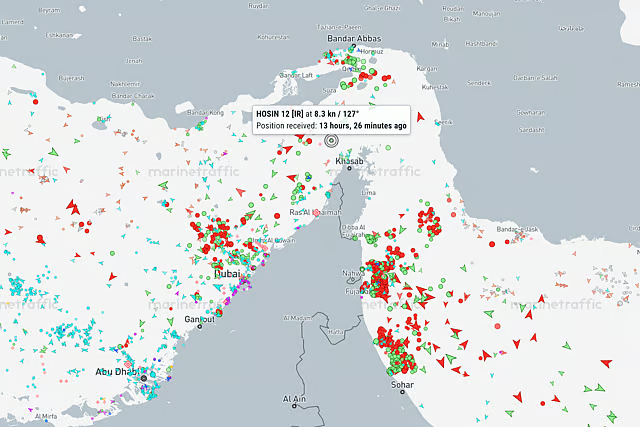
Shipping data indicates that a large majority of vessels carrying liquids are now avoiding routes closer to the Iranian side of the strait. Instead, operators are increasingly using the Omani side or switching off automatic tracking systems in an effort to reduce exposure to Iranian maritime controls.
The shift does not mean Iran has completely lost its influence over the strategic waterway. The Strait of Hormuz remains a high-risk environment, with military activity, elevated insurance costs, security threats and lower overall traffic continuing to affect global energy markets.
But the changing routes suggest that Tehran’s practical ability to dictate how commercial vessels move through the strait may be weakening.
Shipping routes begin shifting toward Oman
The latest shipping data points to a major change in the way vessels navigate the narrow waterway.
According to industry data cited in recent reports, more than 80 per cent of liquids traffic over the past two weeks has either used routes closer to Omani waters or travelled without broadcasting its position through the Automatic Identification System, commonly known as AIS.
That represents a sharp change from earlier in the crisis, when vessels were much less likely to use the Omani-side route.
For shipping companies, the decision is largely about reducing exposure to areas where Iranian forces could potentially exercise greater control.
The Omani-side route provides commercial operators with an alternative path while allowing them to remain within the broader maritime corridor used to move energy between the Gulf and international markets.
The growing use of this route is therefore significant not only for individual ship operators but also for the wider balance of power surrounding the Strait of Hormuz.
Why the Strait of Hormuz matters
The Strait of Hormuz is one of the world’s most strategically important maritime chokepoints.
It connects the Persian Gulf with the Gulf of Oman and the Arabian Sea, providing a critical route for oil and gas exports from major energy-producing countries in the Gulf.
Any prolonged disruption to the waterway can quickly affect international energy markets.
When shipping companies face higher security risks, they may delay voyages, change routes, seek military protection or demand higher insurance premiums. Each of these factors can increase the cost of moving energy around the world.
The current crisis has therefore attracted close attention from governments, energy companies, shipping firms and financial markets.
The question is no longer simply whether vessels can pass through Hormuz, but who can effectively determine the conditions under which that traffic takes place.
US naval protection changes the equation
The growing presence of US military forces has become an important factor in the changing shipping patterns.
American naval forces have provided protection and monitoring for commercial vessels operating through the region. US officials have also claimed that significant volumes of oil continue to move through the wider Hormuz corridor despite the conflict.
The presence of US escorts reduces some of the risks faced by tanker operators and gives companies greater confidence to use routes that might otherwise be considered too dangerous.
It also complicates Iran’s ability to enforce unilateral restrictions.
If commercial vessels can move under US protection, Tehran may find it increasingly difficult to compel all operators to follow Iranian-preferred routes or seek permission from Iranian authorities.
However, military protection does not eliminate the risks.
Iran still has the ability to use missiles, drones, mines and smaller fast-moving vessels to create uncertainty and raise the cost of shipping operations.
Iran’s naval capabilities have been weakened
Another factor influencing the changing balance is the reported degradation of Iran’s conventional naval assets.
The conflict has placed sustained pressure on Iranian military infrastructure, including coastal and maritime capabilities.
A weakened conventional fleet makes it harder for Tehran to maintain continuous control across a busy international waterway.
That does not necessarily mean Iran has lost its ability to disrupt shipping.
The country’s asymmetric capabilities remain a concern. Mines, drones, missiles and fast boats can create significant risks even without requiring complete control of the waterway.
For commercial operators, the possibility of an attack can be enough to influence route decisions.
This explains why shipping patterns can change dramatically even when no single country has absolute control of the strait.
AIS data reveals a changing maritime picture
One of the most important tools for understanding the situation is Automatic Identification System data.
AIS technology allows ships to broadcast information such as their identity, position, speed and course using radio and satellite systems.
But vessels can switch off their AIS systems, creating what shipping analysts describe as “dark” movements.
This makes it more difficult to determine exactly how much traffic is passing through the region.
The apparent reduction in visible vessel numbers should therefore be interpreted carefully.
A decline in AIS-tracked vessels does not necessarily mean an equivalent decline in actual oil movements.
Some vessels may be deliberately keeping their tracking systems off because of security concerns, while others may be involved in ship-to-ship transfers away from the immediate danger zone.
As a result, estimates of oil flows can differ substantially depending on the data source and methodology.
Oil continues to reach global markets
Despite the disruption, oil continues to reach international markets through a combination of maritime rerouting, alternative infrastructure and adjustments by energy companies.
US officials have claimed that millions of barrels of oil are still moving through or around the Hormuz corridor on some days.
However, the precise figures remain difficult to independently verify.
The continued movement of oil is important because it prevents the crisis from immediately turning into a full-scale global supply shock.
At the same time, the fact that oil prices remain elevated indicates that markets continue to price in a substantial geopolitical risk.
Brent crude was trading around $93.75 a barrel on Friday in Asian trading, reflecting continued concern over the security of energy supplies.
Why oil prices remain volatile
The apparent increase in oil flows has not eliminated market concerns.
Investors are still watching the possibility of further attacks, a renewed closure of shipping lanes or additional military escalation.
Higher shipping insurance premiums can also increase the delivered cost of crude even when physical supplies remain available.
There is another issue: spare capacity and alternative export routes cannot necessarily compensate for every disruption.
If the crisis were to intensify and major tankers or LNG carriers were unable to operate normally, the impact could spread quickly across energy markets.
This explains why crude prices can remain high even when some oil continues to move.
Markets respond not only to what is happening today but also to the risk of what could happen next.
The June agreement and its aftermath
A temporary agreement reached in June provided some relief to shipping operators.
The memorandum reportedly included a 60-day period without charges and provisions intended to facilitate safe passage.
However, the arrangement expired around August 17 amid disagreements over its interpretation.
Iran viewed the arrangement as supporting an administrative role in managing maritime traffic, while the United States and Gulf countries rejected the idea that Tehran should have unilateral authority over the international waterway.
The expiration removed one layer of predictability from an already unstable environment.
Shipping companies are consequently relying more heavily on military protection, alternative routing and their own risk assessments.
Iran still insists on its influence
Despite the changing maritime picture, Iran has not abandoned its claims over the Strait of Hormuz.
Tehran continues to argue that it has legitimate security interests in the waterway and has rejected attempts by the United States or other countries to challenge its position.
Iranian officials have insisted that the strait remains under Iranian influence and have rejected claims that Washington has taken control.
The competing claims underline the difference between legal or political influence and practical control.
Iran may still possess substantial capacity to threaten or disrupt maritime traffic without being able to control every commercial vessel.
Similarly, US naval forces may protect selected shipping movements without possessing uncontested control of the entire waterway.
Neither side has complete control
The current situation is therefore more complicated than a simple declaration that Iran has lost the Strait of Hormuz.
The evidence points instead to a fragmented maritime environment.
Commercial vessels are adapting their routes. Some are moving closer to Oman, some are operating under US protection and others are limiting their visibility through AIS.
At the same time, Iran retains asymmetric capabilities capable of increasing risks and costs.
This means the practical balance of power is changing, but the underlying security threat has not disappeared.
Global trade faces wider consequences
The developments in Hormuz extend beyond oil.
The waterway is also important for natural gas, petrochemicals and other commodities moving between the Gulf and global markets.
A prolonged period of uncertainty could force shipping companies to redesign routes, increase security spending and purchase more expensive insurance coverage.
Those additional costs can eventually reach consumers through higher transportation and commodity prices.
Asian economies are particularly sensitive because many depend heavily on energy supplies moving through the Gulf.
Any sustained reduction in energy flows could therefore have consequences for inflation, industrial production and economic growth.
The rise of alternative routes
The crisis is also encouraging governments and companies to reconsider their dependence on a single maritime chokepoint.
Overland pipelines, alternative export terminals and changes in energy consumption can reduce some of the pressure on Hormuz.
Growing electric vehicle adoption may also contribute to longer-term changes in oil demand, although such trends cannot quickly replace the enormous volumes of crude traditionally transported through the region.
For now, the Strait of Hormuz remains indispensable to the global energy system.
The current rerouting represents an adaptation rather than a complete replacement of the traditional trade route.
What happens next?
The future of the Strait of Hormuz will depend heavily on the direction of the US-Iran conflict and the success or failure of diplomatic efforts.
If tensions ease, shipping companies could gradually return to more conventional routes.
If confrontation intensifies, operators may continue favouring Omani waters, military escorts and less visible sailing patterns.
A further escalation could also increase the use of drones, missiles or other asymmetric tactics against shipping.
That would likely push insurance costs higher and place additional pressure on oil prices.
The coming weeks will therefore be closely watched by energy markets and shipping companies around the world.
A changing balance in Hormuz
The latest shipping data suggests Iran’s practical grip on the Strait of Hormuz may be weakening, but it would be premature to describe Tehran as having lost control altogether.
The most important development is the growing ability of commercial operators to bypass Iranian-preferred routes.
US military protection, alternative maritime corridors and adjustments by energy companies are allowing oil to continue reaching global markets despite the conflict.
Yet the overall traffic level remains well below pre-war conditions, while security risks and market volatility remain high.
For now, the Strait of Hormuz has become a test of whether a strategic maritime chokepoint can remain functional when military power, commercial interests and competing political claims collide.
The answer will have consequences not only for Iran and the Gulf but for energy prices, global trade and economic stability far beyond the region.
Dubai Herald will continue tracking developments around the Strait of Hormuz, US-Iran tensions, oil markets, shipping security and their impact on the Gulf region.