

































The UAE’s remittance industry has undergone a dramatic transformation over the past six decades, moving from paper records and three-day transfers to digital transactions that can reach beneficiaries within seconds.
For generations of expatriates, sending money home was once a slow and paperwork-heavy process. Today, technological advances, digital banking and real-time payment systems have made international remittances significantly faster and more convenient.
From paper ledgers to instant transfers
Al Ansari Financial Services Group CEO Rashed A. Al Ansari recalls a time when international transfers could take around three days to reach recipients.
In the early years, exchange houses relied heavily on paper ledgers, carbon copies and traveller’s cheques. Customers had to complete processes that would now seem considerably slower compared with today’s digital services.
The evolution of financial technology has transformed that experience. Many remittances can now be processed almost instantly, allowing expatriates to send financial support to families abroad within seconds.
The change is particularly significant in the UAE, where expatriates make up a large share of the population and regularly send money to relatives in their home countries.
Travel money also becomes easier
The transformation has extended beyond remittances.
Travellers once carried large amounts of physical cash when visiting other countries. The introduction of travel cards gave customers another option, allowing them to load money onto cards, use them for purchases and withdraw cash through ATMs when required.
These developments have made international travel more convenient while reducing the need to carry large amounts of cash.
Compliance remains a key challenge
Despite rapid advances in technology, faster transactions do not eliminate the need for financial security and regulatory checks.
According to Al Ansari, compliance is now one of the biggest factors affecting the speed of financial transactions. Real-time screening of senders and recipients is required to identify potentially suspicious names or accounts.
Partial matches can sometimes trigger manual reviews, slowing down otherwise legitimate transactions.
Financial institutions are increasingly turning to artificial intelligence to address this challenge. AI systems can compare information such as dates of birth and other customer details within seconds, helping distinguish genuine customers from potential risks and reducing unnecessary manual intervention.
From one branch to more than 280
The history of Al Ansari dates back to 1966, when its founder, who was involved in food trading, began using existing commercial networks to facilitate money transfers for expatriate workers.
The company obtained a licence in Abu Dhabi five years before the UAE was formed and opened its first branch in Abu Dhabi’s Central Market.
Six decades later, the business has grown into one of the country’s largest exchange and remittance networks, with more than 280 branches and plans to surpass 300.
The group has also expanded internationally, with operations in Bahrain, Kuwait and India. Its acquisition of Bahrain-based BFC Group for $200 million further strengthened its regional presence, while regulatory approval is awaited for an expansion into Oman.
Digital remittances gain ground
One of the clearest signs of the industry’s transformation is the growth of digital transactions.
When the Al Ansari Exchange app was launched in 2018, only about 1 per cent of remittances were processed digitally. Today, digital transactions account for around 30 per cent of its remittance activity.
The shift accelerated during the Covid-19 pandemic, as customers increasingly turned to digital financial services.
The company expects digital remittances to continue growing and estimates that they could account for about 60 per cent of transactions within the next five years. At peak periods, the app can process more than 600,000 transactions in a month.
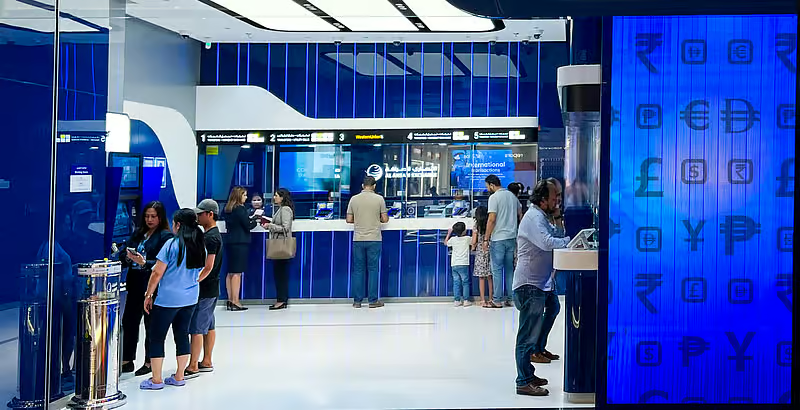
However, physical branches continue to play an important role. Some customers, including domestic workers and labourers, still prefer face-to-face services because of factors such as language barriers, familiarity with branches or limited access to smartphones.
Six decades of compliance
As Al Ansari marks 60 years of operations, compliance remains a major focus.
The company says it has not been fined by the UAE Central Bank during its six decades of operation and aims to maintain strong regulatory standards while ensuring that financial services remain accessible to ordinary customers.
The UAE’s remittance sector is likely to continue evolving as artificial intelligence, digital payments and automated compliance systems become more deeply integrated into financial services.
From three-day transfers and paper ledgers to transactions completed within seconds, the industry’s journey reflects the wider digital transformation of the UAE’s financial landscape.