

































The conflict between the United States and Iran intensified on Wednesday as the two sides exchanged attacks around the Strait of Hormuz, while Iran also launched a missile strike targeting a US military facility in Jordan.
The latest escalation has heightened concerns over the security of one of the world’s most important oil shipping routes and pushed crude prices closer to the psychologically significant $100-a-barrel mark.
The confrontation follows a series of attacks involving Iranian oil tankers, US naval forces and vessels attempting to navigate the strategic waterway.
Iran Targets US Vessels in Hormuz
Iran’s Islamic Revolutionary Guard Corps said it had attacked two US vessels, eight oil tankers and several other vessels attempting to cross what Tehran described as a prohibited and unsafe area of the Strait of Hormuz.
The claims came after US forces struck five Iranian oil carriers on Tuesday.
Washington said those attacks followed attempted Iranian strikes against a US Navy warship. US Central Command said crews aboard the targeted tankers had been warned to leave before the vessels were rendered inoperable.
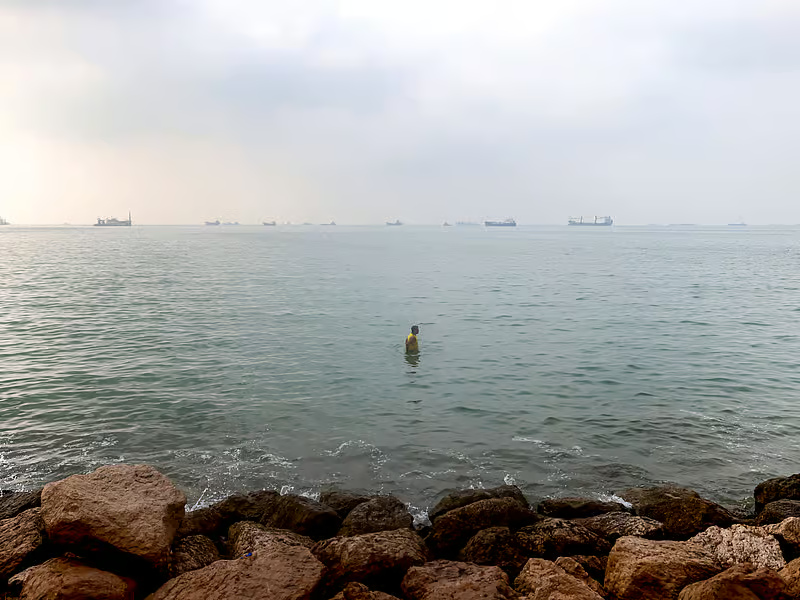
The confrontation has raised fresh concerns about commercial shipping through the narrow waterway, through which a significant share of global oil supplies normally passes.
Iran Launches Missile Attack on Jordan
The conflict also expanded beyond the Gulf after Iran said it had targeted a US military base in Jordan.
Jordanian authorities said their air defences intercepted 18 of 20 missiles launched from Iran. The remaining missiles landed in unpopulated areas, and authorities reported no casualties.
Officials urged residents to stay away from debris and areas affected by the missile interceptions as emergency teams worked to clear the sites.
The attack represents another sign that the confrontation is increasingly spreading across the wider region, with countries allied to Washington facing heightened security risks.
Tehran Issues Warning to Tankers in Kuwait and Bahrain
Iran has also threatened oil tankers operating from ports in Kuwait and Bahrain.
In a statement carried by Iranian state media, the Revolutionary Guard warned vessels in the two countries to leave, saying they could become targets because of the countries’ association with the United States.
The warning has added another layer of uncertainty for shipping companies and energy markets already dealing with increased military activity across the region.
Any prolonged disruption around the Strait of Hormuz could have consequences well beyond the Middle East because of the waterway’s importance to international energy trade.
Oil Prices Move Towards $100
Energy markets reacted quickly to the latest developments.
Brent crude climbed to around $99.46 a barrel in Asian trading on Wednesday, while US West Texas Intermediate crude reached approximately $94.45.
Oil prices have risen sharply in recent weeks as renewed fighting has increased concerns about production, transportation and access to key export routes.
Analysts say the market is increasingly pricing in a risk premium as hopes for a lasting diplomatic settlement weaken.
The possibility of further disruption in the Gulf has become a central concern for traders, particularly if attacks begin affecting commercial shipping on a sustained basis.
US Says Iranian Tankers Were Struck After Attacks
The United States said its forces destroyed five Iranian oil carriers on Tuesday.
According to US Central Command, the action followed repeated ballistic missile attacks by Iran against an American warship.
The US military said crews were given evacuation warnings before the vessels were struck.
Iran, meanwhile, accused Washington of escalating the confrontation and reported that another Iranian tanker had been hit near Kharg Island, a major hub for the country’s oil exports.
Reports of explosions were also heard around the southern Iranian port of Jask, according to Iranian media.
Iran Claims Capture of US Underwater Drone
Adding to the growing military confrontation, Iran’s Revolutionary Guard said it had captured a US unmanned underwater vehicle in the Strait of Hormuz.
Iranian authorities described the device as an advanced unmanned submarine.
The US military said the underwater drone had malfunctioned and was not carrying sensitive information.
The incident highlights the expanding use of unmanned systems in the conflict and the increasingly contested environment around the Strait of Hormuz.
Iran also claimed that an advanced MQ-1 drone had been destroyed over the strait after what it described as an attempted drone attack.
Yemen Front Adds to Regional Pressure
The conflict has also been linked to renewed fighting involving Yemen’s Houthi movement.
US Secretary of State Marco Rubio said Iran had played a role in recent Houthi attacks against Saudi Arabia, describing the group as closely connected to Tehran.
The Houthis have launched a new offensive in areas close to the Bab al-Mandab Strait, another strategically important maritime route connecting the Red Sea with the Gulf of Aden.
The renewed fighting has raised fears that disruptions could affect more than one major shipping corridor in the region.
Washington Expands Sanctions on Iranian Airlines
Alongside the military confrontation, the United States has increased economic pressure on Tehran.
Washington announced sanctions targeting remaining Iranian airlines that had not previously been subjected to US restrictions.
The US Treasury Department said the latest measures cover 36 targets associated with Iran’s aviation sector, accusing the industry of helping the Iranian government move weapons, personnel and illicit cargo.
The new sanctions add to a growing package of financial and economic measures against Tehran as military tensions continue to rise.
What Happens Next?
The latest exchange of attacks has significantly increased uncertainty across the Gulf.
The Strait of Hormuz remains the most immediate concern for global energy markets, while the missile attack on Jordan and threats against vessels in Kuwait and Bahrain indicate that the confrontation could widen further.
For Gulf countries, shipping operators and energy markets, the key question now is whether the latest attacks remain limited or develop into a sustained campaign against military and commercial targets.
As the US and Iran continue to trade threats and strikes, the risk of further disruption across the Middle East remains high.